Access Options
Member Only Content
Please log in to view availability or download this document.
| Published | July 27, 1999 |
|---|---|
| Type | Project Report |
| Thematic Category | Land Resources |
| Project | Wasteland Mapping of Mizoram |
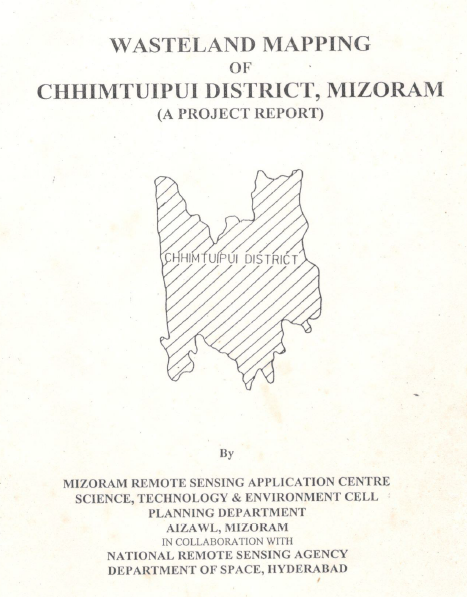
Wasteland Mapping of Chhimtuipui district, Mizoram
Abstract / Description
The Wasteland Mapping for Chhimtuipui district was carried out under the national Phase V programme initiated by the National Remote Sensing Agency (NRSA), Department of Space, Government of India, during 1997–99. The project was undertaken by the Mizoram Remote Sensing Application Centre with the objective of generating a comprehensive and spatially explicit database on wasteland distribution to support informed planning for land development and ecological restoration in the state.
The study employed satellite remote sensing techniques, utilizing IRS-1B imagery acquired through the LISS-II sensor, with thematic mapping carried out at a scale of 1:50,000. Visual interpretation methods were adopted to delineate and classify wasteland categories within the district’s complex terrain, characterized by steep slopes, fragile geology, and intensive land-use practices. The approach ensured consistent identification of degraded land units across varying physiographic conditions.
The analysis reveals that shifting cultivation remains the predominant contributor to wasteland formation in the district, with both active (current jhum) and fallow (abandoned jhum) areas forming a substantial proportion of the degraded landscape. In addition, degraded notified forest lands were identified, reflecting the cumulative impact of anthropogenic pressures such as repeated clearing, shortened fallow cycles, and unsustainable resource extraction. The spatial distribution of these categories highlights a clear pattern of land degradation linked to traditional agricultural practices under increasing demographic and environmental stress.
The project generated district-level thematic maps and associated spatial datasets that provide a clear representation of wasteland extent and distribution. These outputs form a critical baseline for understanding the dynamics of land degradation and for prioritizing intervention areas.
A key outcome of the study is the formulation of land-specific reclamation and management strategies aimed at enhancing productivity while ensuring ecological sustainability. Based on land capability assessment, a range of interventions has been recommended, including silvipasture development, afforestation and silviculture, horticultural plantations, agro-horticulture systems, and improved agricultural practices. These measures are designed to stabilize degraded slopes, restore vegetative cover, and optimize land use in accordance with local environmental conditions.
Overall, the study provides a scientifically robust framework for wasteland management in Chhimtuipui district. The integration of geospatial analysis with practical land-use recommendations makes this report a valuable resource for planners, policymakers, and development agencies in designing targeted programmes for sustainable land resource management and long-term ecological resilience in Mizoram.
Summarized Metadata
Mapping Scale: 1:50,000
Satellite data & Year: IRS 1B (1995)
Thematic sub-category: Wasteland, Spatial Planning
Collaborating/Funding Agency: National Remote Sensing Centre (NRSC), Hyderabad
Report Publication Month/Year: July, 1999