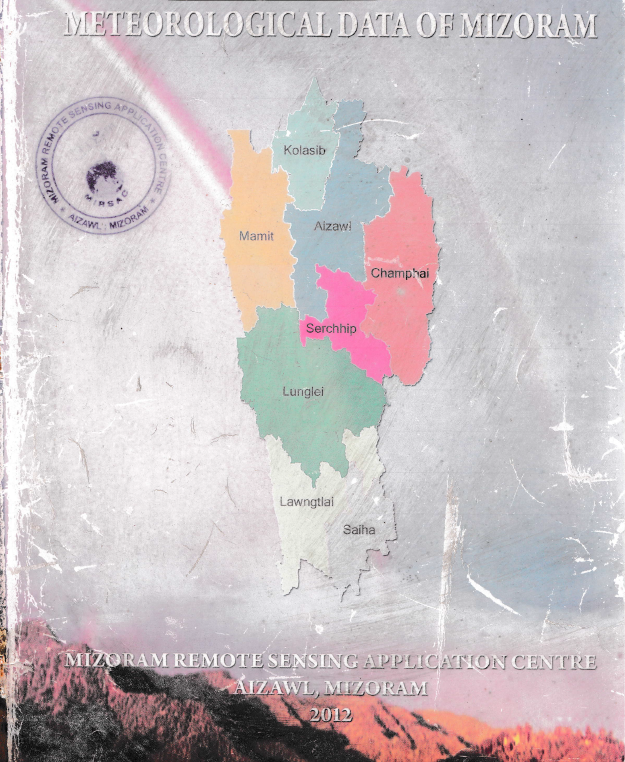
Meteorological Data of Mizoram - 2012
The “Meteorological Data of Mizoram – 2012” report represents the second-phase update of the Meteorological Data of Mizoram project undertaken by the Mizoram Remote Sensing Application Centre (MIRSAC). Building upon the original meteorological compilation published in 2009, this edition extends the available climatic database up to 2011, thereby providing a longer temporal reference for understanding the State’s rainfall, temperature and relative-humidity characteristics. The principal objective was to consolidate dispersed meteorological observations into a systematic, readily accessible database for use in Remote Sensing and GIS studies, natural-resource assessment, development planning and scientific research. Primary observations were compiled from the Department of Agriculture, Department of Economics & Statistics, BRTF–Project Pushpak and Directorate of Science & Technology, Government of Mizoram, supplemented by available meteorological information from MOSDAC and AccuWeather.The report provides district-wise information for all eight districts of Mizoram, with rainfall series extending largely from 1986 to 2011, although temporal coverage varies according to data availability. Temperature information was expanded considerably compared with the earlier edition and is presented for all eight districts, while relative-humidity observations remained more spatially limited. The database demonstrates the strongly monsoonal character of Mizoram’s climate, with rainfall concentrated primarily between May and September. At the State level, the compiled district averages indicate an annual rainfall of approximately 2,693.4 mm, with monthly averages increasing from only 9.3 mm in January to 452.4 mm in July and 460.9 mm in August, before declining after September. This pronounced seasonal concentration has important implications for agriculture, water-resource availability, erosion, landslides and infrastructure management.Temperature observations indicate a generally moderate but seasonally distinct thermal regime. The State-level monthly average mean temperature increases from about 17.5°C in January to approximately 25–26°C during May–September. Average monthly maximum temperatures reach around 33.1°C during April–May, whereas the average minimum falls to about 9.4°C in January. Considerable spatial variation is evident between the warmer lower-elevation districts and cooler elevated locations. Relative humidity likewise follows the monsoonal cycle, increasing substantially from the relatively drier winter and pre-monsoon months and remaining generally around or above 89–92% during the core monsoon months of July–September.Overall, the project established an important long-term meteorological baseline for Mizoram, while also revealing spatial and temporal gaps in the historical observation network. The resulting tables, charts and district-wise climatic summaries constitute a valuable reference for agriculture and horticulture, hydrology, forestry, environmental assessment, disaster-risk studies, infrastructure design, climate analysis and Remote Sensing/GIS modelling, and provide a foundation for continued meteorological database development and future climate-change assessments. Summarized MetadataMapping Scale: N.A Satellite data & Year: N.AThematic sub-category: Meteorology; Climate; Weather dataCollaborating/Funding Agency: Mizoram Remote Sensing Application Centre (MIRSAC)Report Publication Month/Year: May, 2012
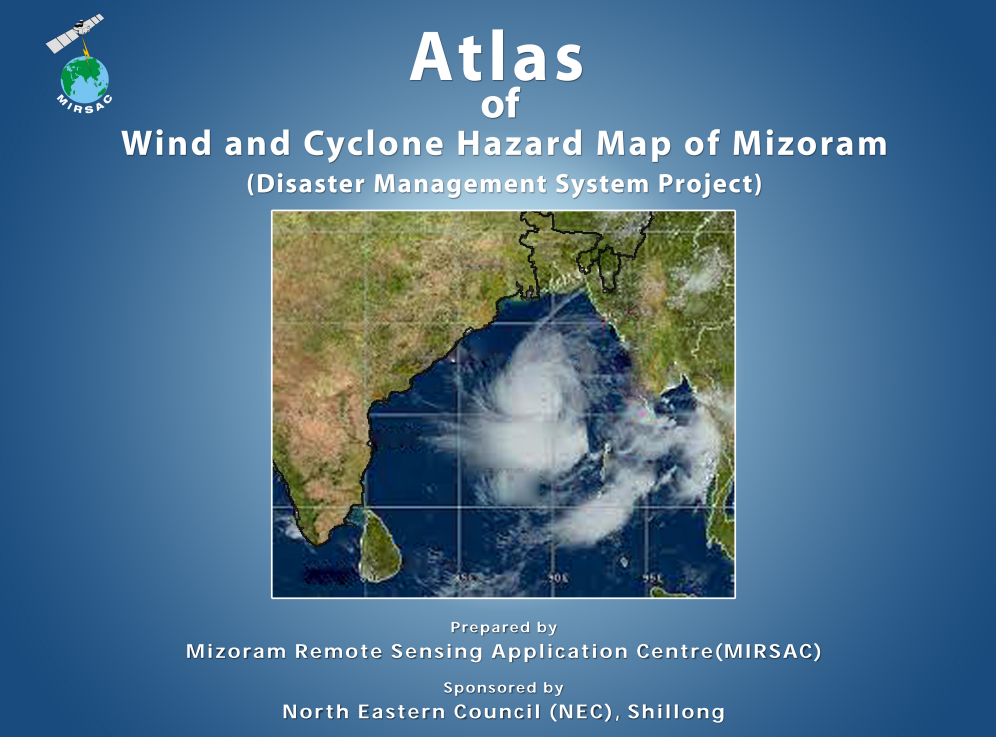
Atlas of Wind & Cyclone Hazard Map of Mizoram
The “Atlas of Wind and Cyclone Hazard Map of Mizoram” was prepared by the Mizoram Remote Sensing Application Centre (MIRSAC), Science & Technology, Planning Department, Government of Mizoram, as part of the broader Disaster Management System (DMS) Project funded by the North Eastern Council (NEC), Shillong. Although wind and cyclone hazard mapping was not included in the original project design, its importance emerged during implementation because Mizoram is periodically affected by tropical cyclonic systems originating from the Bay of Bengal and by destructive monsoon storms. The study therefore aimed to identify and spatially classify areas of varying wind and cyclone hazard across Mizoram and generate a geospatial baseline for disaster preparedness, mitigation and development planning.The assessment employed Satellite Remote Sensing and Geographic Information System (GIS) techniques using IRS LISS-III satellite imagery, ESRI World Map datasets, Meteorological and Oceanic Satellite Data Archival Centre (MOSDAC) information and other ancillary spatial datasets. The resulting hazard maps integrated the zonation with settlements and different classes of road infrastructure, making the outputs suitable for administrative and infrastructure-oriented applications. The analysis classified the State into three broad hazard categories: Very High, High and Moderate wind and cyclone hazard zones.Across Mizoram's total geographical area of 21,087 sq. km, approximately 3,737.40 sq. km (17.68%) was classified as Very High hazard, while 7,285.57 sq. km (34.50%) fell under the High hazard category. The remaining 10,064.03 sq. km (47.82%) was categorized as Moderate. Thus, more than half of the State, approximately 52.18% or 11,022.97 sq. km falls within High or Very High wind and cyclone hazard zones.A marked spatial gradient was evident across the State. Lawngtlai District exhibited the highest proportion of Very High hazard terrain, with 53.29% of its area in this category and another 38.30% classified as High, meaning more than 91% of the district falls within the two highest hazard classes. Saiha District similarly recorded 35.52% Very High and 43.73% High hazard, while Lunglei District contained 34.50% Very High and 39.66% High hazard. In contrast, northern districts were comparatively less exposed; Kolasib District was almost entirely Moderate hazard (99.63%) with no mapped Very High zone.Overall, the Atlas reveals a clear concentration of higher wind and cyclone hazard toward the southern and southwestern parts of Mizoram, consistent with their greater exposure to cyclonic influence. The generated hazard maps and GIS database provide valuable decision-support information for Disaster Management Plans, resilient infrastructure design, settlement and road planning, agricultural protection, emergency preparedness and prioritization of preventive measures, establishing an important baseline for future wind- and cyclone-risk assessment in Mizoram. Summarized MetadataMapping Scale: 1:50,000 Satellite data & Year: IRS P6 LISS III, LISS IV, Cartosat I & QuickbirdThematic sub-category: Disaster Management; Wind & CycloneCollaborating/Funding Agency: North Eastern Council, ShillongAtlas Publication Month/Year: September, 2011
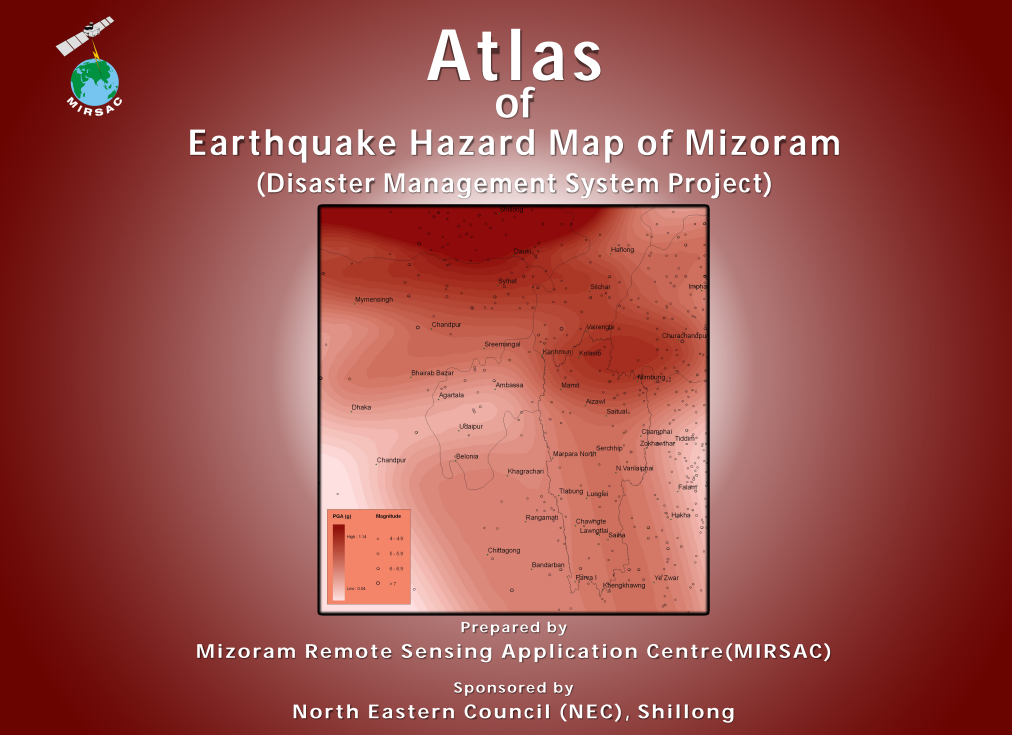
Atlas of Earthquake Hazard Map of Mizoram
The “Atlas of Earthquake Hazard Map of Mizoram” was prepared by the Mizoram Remote Sensing Application Centre (MIRSAC), Science & Technology, Planning Department, Government of Mizoram, as a major component of the Disaster Management System (DMS) Project, funded by the North Eastern Council (NEC), Shillong. Published in September 2011, the study was undertaken in recognition of Mizoram’s high seismic vulnerability within Northeast India, a region classified under Seismic Zone V by the Bureau of Indian Standards. The principal objective was to assess and spatially represent variations in earthquake hazard across the State and to establish a geospatial database capable of supporting disaster-management planning, infrastructure development and earthquake-risk mitigation.The assessment integrated Satellite Remote Sensing and Geographic Information System (GIS) techniques with regional tectonic information and historical seismicity. Input datasets included IRS LISS-III satellite imagery, regional tectonic maps and earthquake catalogues obtained from the India Meteorological Department (IMD), International Seismological Centre (ISC), Advanced National Seismic System/USGS and NEIST, Jorhat, together with ancillary spatial information. Technical capacity for the study was further supported through specialized training provided by the Wadia Institute of Himalayan Geology, Dehradun. Earthquake hazard was expressed in terms of Peak Ground Acceleration (PGA) with a 10% probability of exceedance in 100 years, and maps were prepared at 1:50,000 scale for Mizoram and its eight districts existing at the time.The statewide analysis covered 21,087 sq. km and indicated PGA values ranging approximately from 0.30 g to 0.54 g, demonstrating considerable spatial variation in expected seismic ground motion. The two dominant classes were 0.36–0.38 g, covering 6,057.50 sq. km (28.73%), and 0.34–0.36 g, covering 5,924.95 sq. km (28.10%); together they account for about 56.83% of the State. A further 2,350.73 sq. km (11.15%) falls within the 0.32–0.34 g class. At the higher end of the hazard spectrum, areas with PGA values of 0.50–0.54 g account for approximately 1,888.47 sq. km (8.95%), while PGA values of 0.44 g and above collectively affect a substantial portion of the State.Distinct district-level differences were evident. Champhai District displayed one of the widest PGA ranges, extending from 0.30–0.32 g to 0.50–0.52 g, whereas Saiha District was confined mainly to 0.34–0.38 g, with 64.46% of its area in the 0.36–0.38 g category. Lunglei similarly showed predominantly moderate PGA values, with 47.22% of its area in the 0.34–0.36 g range.Overall, the Atlas provides an important scientific baseline for earthquake-resistant infrastructure planning, building regulation, settlement development, lifeline-network protection, emergency preparedness and State and District Disaster Management Plans. Its GIS-based hazard maps enable planners to incorporate spatial variations in expected seismic ground motion into long-term development and risk-reduction strategies across Mizoram. Summarized MetadataMapping Scale: 1:50,000 Satellite data & Year: IRS P6 LISS III, LISS IV, Cartosat I & QuickbirdThematic sub-category: Disaster Management; EarthquakeCollaborating/Funding Agency: North Eastern Council, ShillongAtlas Publication Month/Year: September, 2011
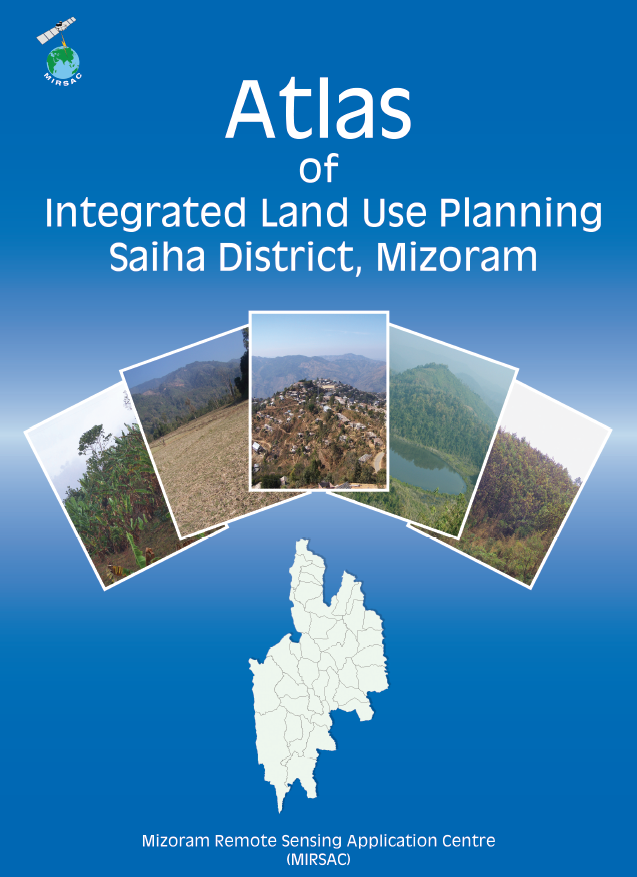
Integrated Land Use Planning of Saiha District
The “Atlas of Integrated Land Use Planning of Saiha District, Mizoram”, prepared by the Mizoram Remote Sensing Application Centre (MIRSAC), Science & Technology, Planning Department, represents a district-wide geospatial initiative designed to translate natural-resource information into practical land- and water-development strategies. The Atlas was developed in support of scientifically guided development and implementation of the New Land Use Policy (NLUP). Its principal objective was to formulate appropriate land-use options for individual villages by integrating natural-resource potential, terrain constraints, existing land utilization and infrastructure within a Remote Sensing and GIS-based planning framework.The project employed multi-resolution satellite datasets including IRS LISS-III, IRS LISS-IV, Cartosat-I and QuickBird imagery. These datasets were used to assess existing land use, terrain and slope, soil characteristics, permanent agricultural and horticultural areas, rainfall conditions, groundwater and surface-water resources, settlements and transport connectivity. The thematic information was subsequently integrated within a Geographic Information System (GIS) to identify spatially appropriate development options. A notable feature of the Atlas is its village-level approach, in which individual settlements are represented through paired map products—one showing transport networks, settlements and drainage, and the other presenting the corresponding Integrated Land Use Plan. Preparation of the Atlas also involved cooperation from the Saiha District Administration, various Government departments and Village Councils during data provision and field verification.At the district level, the planning exercise covered 1,399.90 sq. km. Proposed productive land-development interventions included 37.61 sq. km for WRC/pisciculture, 38.23 sq. km for terrace cultivation, 64.04 sq. km for agro-horticulture, 58.52 sq. km for agriculture/horticulture plantations, 137.86 sq. km for silviculture and pasture development, and 100.94 sq. km for afforestation. Collectively, these proposed development categories account for approximately 437.20 sq. km, or 31.23% of the district area.The Atlas simultaneously recognized the importance of retaining major natural and protected landscapes. Forest constituted 585.26 sq. km (41.81%), bamboo occupied 178.31 sq. km (12.74%), and Reserve Forests, plantations and departmental lands accounted for another 177.49 sq. km (12.68%). Water bodies covered 9.06 sq. km (0.65%), while built-up areas accounted for 12.58 sq. km (0.90%).Water-resource planning formed a particularly substantial component of the study. The district-wide plan proposed 1,532 water-development structures, comprising 1,094 check dams, 169 rainwater-harvesting ponds, 119 intake weirs, 20 distribution tanks and 130 irrigation channels. Overall, the Atlas demonstrates the practical application of satellite Remote Sensing, GIS and field information for micro-level, village-oriented resource planning, providing an important decision-support database for NLUP implementation, agriculture and horticulture development, soil and water conservation, forestry, watershed management, infrastructure planning and sustainable rural development in Saiha District. Summarized MetadataMapping Scale: 1:10,000 Satellite data & Year: IRS P6 LISS III, LISS IV, Cartosat I & Quickbird (2009-2010)Thematic sub-category: Land resources; Village level planningCollaborating/Funding Agency: Science & Technology, Planning Department, Government of MizoramAtlas Publication Month/Year: August, 2011
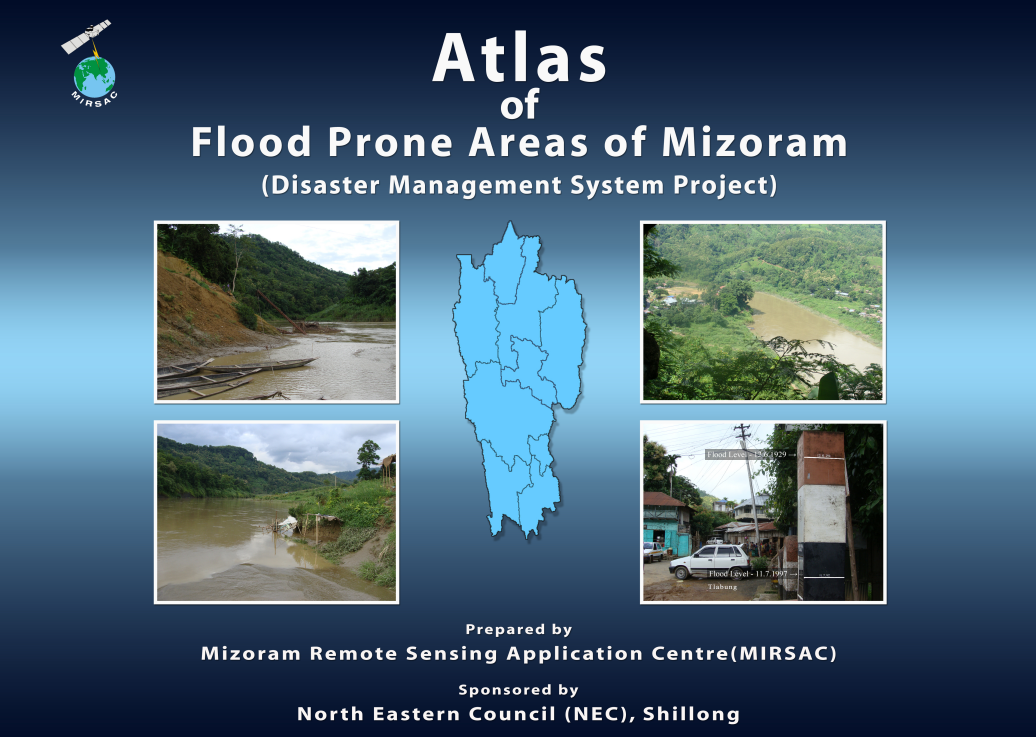
Atlas of Flood Prone areas of Mizoram
The “Atlas of Flood Prone Areas of Mizoram” was prepared by the Mizoram Remote Sensing Application Centre (MIRSAC), Science & Technology, Planning Department, Government of Mizoram, as a component of the broader Disaster Management System (DMS) Project, funded by the North Eastern Council (NEC), Shillong. The study was undertaken to systematically identify and spatially delineate areas susceptible to flooding across Mizoram and to provide a scientific geospatial database for disaster preparedness, mitigation and development planning. Although large-scale riverine flooding is relatively limited in Mizoram because of its predominantly mountainous terrain, downstream valleys and low-lying utilisable lands are periodically affected during the monsoon, with intense rainfall and flash floods causing damage to agricultural land, crops, infrastructure and, occasionally, human life.The flood-prone area assessment employed IRS LISS-III satellite imagery, Survey of India topographic maps and ancillary datasets, integrated through Remote Sensing and Geographic Information System (GIS) techniques. Flood hazard zonation was undertaken at 1:50,000 scale, with the resulting maps incorporating drainage networks, perennial and non-perennial streams, settlements and different categories of roads to provide an administratively useful spatial context. The Atlas contains statewide and district-wise flood-hazard maps covering all eight districts existing at the time of the study.The statewide analysis covered Mizoram's 21,087 sq. km geographical area and identified approximately 89.84 sq. km of river regime, within which 37.25 sq. km was classified as flood-prone. Thus, while mapped flood-prone areas constitute only about 0.18% of the State's geographical area, they represent a substantially larger proportion of the limited valley and riverine environments where human activities and cultivable land are concentrated. District-level results reveal considerable spatial variation. Lunglei recorded the largest mapped flood-prone area at 11.00 sq. km, followed by Lawngtlai with 8.20 sq. km, Mamit with 6.35 sq. km and Champhai with 4.49 sq. km. Smaller mapped extents occurred in Serchhip (1.92 sq. km), Kolasib (1.77 sq. km), Aizawl (1.77 sq. km) and Saiha (1.75 sq. km).The Atlas demonstrates that flood risk in Mizoram is spatially localized rather than geographically extensive, being concentrated principally along lower river valleys and areas influenced by catchment characteristics such as drainage configuration, slope, land condition and rainfall intensity. The resulting flood-hazard maps and GIS database provide an important baseline for Disaster Management Plans, flood-mitigation measures, infrastructure planning, agricultural planning, emergency preparedness and identification of vulnerable settlements and assets, while also providing a framework for future updating using higher-resolution satellite, terrain and hydrometeorological datasets. Summarized MetadataMapping Scale: 1:50,000 Satellite data & Year: IRS P6 LISS III, LISS IV, Cartosat I & QuickbirdThematic sub-category: Disaster Management; FloodCollaborating/Funding Agency: North Eastern Council, ShillongAtlas Publication Month/Year: May, 2011