Access Options
Member Only Content
Please log in to view availability or download this document.
| Published | July 27, 1999 |
|---|---|
| Type | Project Report |
| Thematic Category | Land Resources |
| Project | Wasteland Mapping of Mizoram |
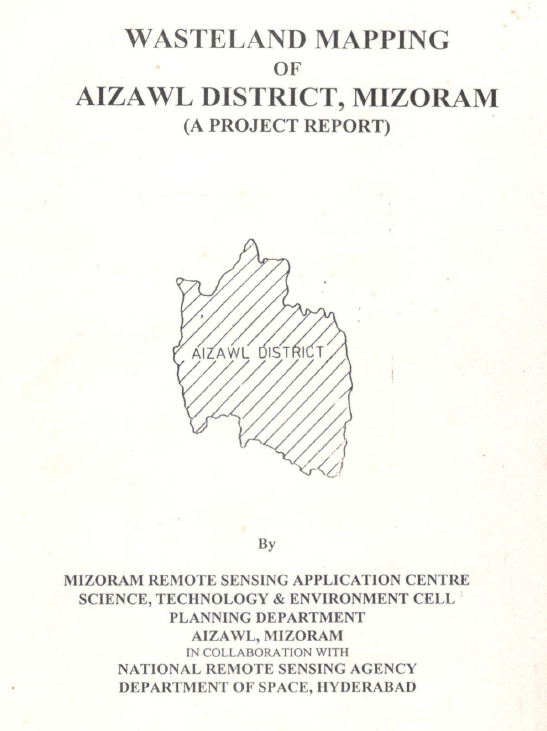
Wasteland Mapping of Aizawl District, Mizoram
Abstract / Description
The Wasteland Mapping Project for Aizawl district was undertaken as part of the nationwide Phase V programme initiated by the National Remote Sensing Agency (NRSA), Department of Space, Government of India, during 1997–99. The project aimed to generate a systematic spatial database on wasteland distribution to support scientific planning for land resource development and ecological restoration. In Mizoram, the study was carried out by the Mizoram Remote Sensing Application Centre under the Science, Technology & Environment Cell, Planning Department, in coordination with NRSA, Hyderabad.
The primary objective of this district-level study was to identify, delineate, and quantify wasteland categories within Aizawl district using satellite remote sensing techniques. The analysis was based on visual interpretation of IRS-1B LISS-II geocoded False Colour Composites (FCCs) acquired in 1995 at a scale of 1:50,000, supplemented by ground truth verification, Survey of India topographical sheets, and ancillary data. This approach enabled accurate mapping of degradation amid steep slopes (>50° dominant), high rainfall (2,802 mm annual average), and Surma Group geology prone to erosion.
The study identified shifting cultivation (jhum) as the dominant wasteland category, comprising current jhum (743.52 sq km; 5.91% of district area) and abandoned jhum/scrub (1,684.37 sq km; 13.38%) alongside degraded notified forest land (193.05 sq km; 1.53%; e.g., Dampa Wildlife Sanctuary). Total wastelands spanned 2,620.94 sq km (20.82%), with hotspots in topo sheets 84E8 (33.48%), 84A5 (26.64%), and watersheds like 3D1B6b (36.65%). These reflect jhum-driven erosion, nutrient depletion, and forest conversion in hilly terrain.
The project generated detailed thematic maps, watershed-wise statistics, and a digital vector database, providing a baseline for land degradation dynamics and priority interventions.
A key component was site-specific reclamation strategies tailored to slope, soil (pH 4-6.5, loamy skeletal), and location: silvipasture (e.g., Ficus hirta, Stylosanthes spp.) on hilltops; sericulture (Morus indica); silviculture (Tectona grandis); horticulture (Citrus spp., Musa spp.); agro-horticulture with Sloping Agricultural Land Technology (SALT); and wetland rice via irrigation. The findings offer policymakers and agencies a geospatial framework for sustainable development, optimizing resources and mitigating jhum impacts in Aizawl district.
Summarized Metadata
Mapping Scale: 1:50,000
Satellite data & Year: IRS 1B (1995)
Thematic sub-category: Wasteland, Spatial Planning
Collaborating/Funding Agency: National Remote Sensing Centre (NRSC), Hyderabad
Report Publication Month/Year: July, 1999