Access Options
Member Only Content
Please log in to view availability or download this document.
| Published | December 07, 2004 |
|---|---|
| Type | Project Report |
| Thematic Category | Geosciences & Disaster Management |
| Project | Vulnerability analysis of cyclone in Mizoram |
Vulnerability analysis of cyclone in Mizoram
Abstract / Description
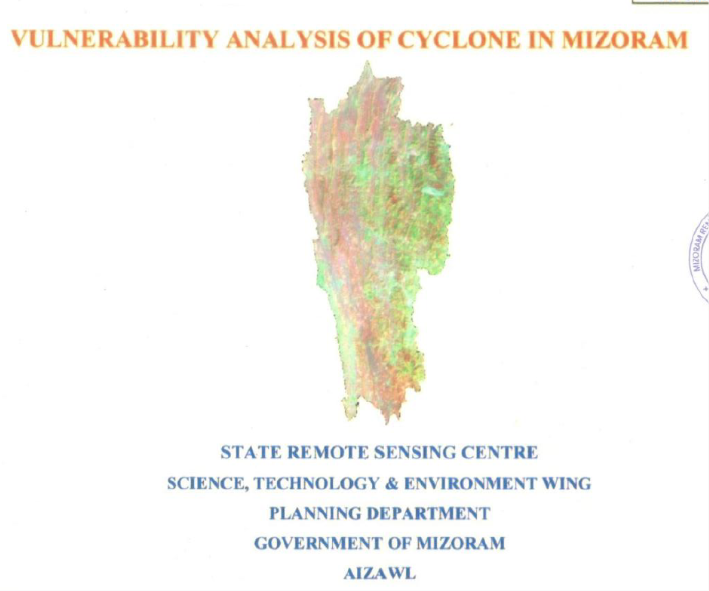
The Vulnerability Analysis of Cyclone in Mizoram State was executed by the State Remote Sensing Centre (SRSC), Science, Technology & Environment Wing, Planning Department, Government of Mizoram, Aizawl. Stemming from a Hazard Mapping meeting on April 13, 2004, chaired by the Secretary, Relief & Rehabilitation, the project was funded by the Relief & Rehabilitation Department., Government of Mizoram.
Covering Mizoram (21,087 sq km) strategically bordered by Bangladesh (west) and Myanmar (east/south), featuring NNW-SSE trending ridges with humid tropical climate (250–350 cm annual rainfall and temparatures ranging from 11–31°C, the study analyzed cyclone impacts using 20-year records (1985–2004) from eight districts (Mamit, Kolasib, Aizawl, Champhai, Serchhip, Lunglei, Lawngtlai, Saiha) and 2001 Census data.
The methodology integrated IRS LISS-III FCC visual interpretation, SOI topographical maps for physiographic parameters (location: ridge/hill-top/slope/valley; aspect: N/NE/E/SE/S/SW/W/NW; altitude: 0–500/501–1,000/>1,001 m), and ArcInfo GIS for vulnerability zoning: low (0–3 events), medium (4–6), high (≥7). Of 828 villages/towns/wards, 450 (54.4%) were low vulnerability, 243 (29.3%) medium, and 135 (16.3%) high.
District-wise observation and analysis showed that Saiha topped high vulnerability (23/77 wards; 29.87%), followed by Lunglei (52/185; 28.11%), Lawngtlai (16/139; 11.51%), Champhai (12/85; 14.12%), Aizawl (15/160; 9.38%), Kolasib (11/52; 21.15%), Mamit (4/87; 4.6%), Serchhip (2/43; 4.65%). Locationally, ridge/hill-tops dominated high vulnerability (e.g., 82.69% in Lunglei; 93.33% in Aizawl), vs. slopes (20.17% overall) and valleys (18.24%). Altitude-wise, high vulnerability peaked at 501–1,000 m (56/135; 41.5%) and >1,001 m (45; 33.3%). Aspect vulnerabilities varied throughout the locations e.g., NW highest in Lunglei (23.07%), E in Kolasib (54.55%). Cyclones (post/pre-monsoon tails from Bay of Bengal; est. Saffir-Simpson scale 2–3: 43–58 m/s) caused house/powerline/road/crop/livestock damage, exacerbated by Assam-type/thatched/tin-roof structures on exposed saddles/ridges.
The project produced thematic maps, tables (village/ward/district/aspect/altitude-wise), and a cyclone database, marking SRSC's first disaster management effort. Outputs enable risk-based planning: prioritize retrofitting high-vulnerability ridge-tops (>501 m), enforce cyclone-resistant designs (sloping roofs at 33:10, J-bolts/anchors/bracing/bands, leeward sites, windbreaks like tree belts), avoid saddles/protrusions, and integrate into mitigation cycles (preparedness/response/recovery).
Recommendations from the project outputs emphasize wind-loading standards, RCC slabs, reinforced walls/frames, minimal projections, and firm foundations against torrential rains, fostering resilient infrastructure amid Mizoram's frequent moderate cyclones.
Summarized Metadata
Mapping Scale: 1:50,000
Satellite data & Year: IRS LISS III (2003)
Thematic sub-category: Disaster management
Collaborating/Funding Agency: Relief & Rehabilitation Department, Govt. of Mizoram
Report Publication Month/Year: December, 2004