Access Options
Member Only Content
Please log in to view availability or download this document.
| Published | March 01, 2003 |
|---|---|
| Type | Project Report |
| Thematic Category | Agriculture & Allied |
| Project | Identification and prioritization of suitable sites for passion fruit using Remote Sensing and GIS technique in Aizawl district, Mizoram state |
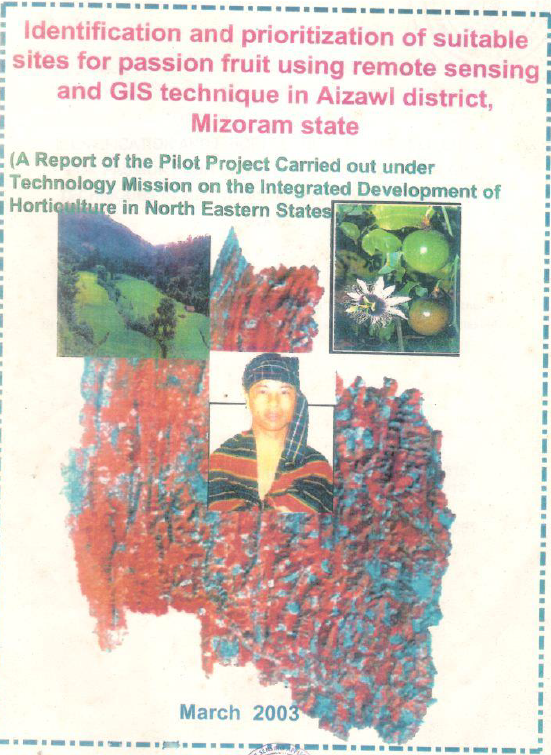
Identification and prioritization of suitable sites for passion fruit using Remote Sensing and GIS technique in Aizawl district, Mizoram state
Abstract / Description
The project “Identification and Prioritization of Suitable Sites for Passion Fruit using Remote Sensing and GIS Techniques in Aizawl District, Mizoram” was undertaken as a pilot initiative under the Technology Mission for Integrated Development of Horticulture in the North Eastern States, with the goal of transforming current jhum lands into sustainable, high-value horticulture. The main objectives were to (i) map current jhum areas in the undivided Aizawl district, (ii) characterize them using terrain and accessibility parameters, (iii) develop site suitability indices for purple and yellow passion fruit, and (iv) prioritize suitable sites for phased horticultural development at village level.
The study focused on two contrasting horticultural circles. Champhai, in Khawzawl division, is a higher-elevation, steep terrain zone that already hosts most of Mizoram’s purple passion fruit and grape orchards. Kolasib, in Aizawl division, is relatively low-lying and gently sloping, dominated by arecanut and citrus, and was hypothesized to be suitable for yellow passion fruit. The wider context is a humid tropical hill state where about 70% of the population depends on agriculture, shifting cultivation remains widespread, and horticulture is a key strategy for livelihood enhancement and land degradation control.
Methodologically, the project integrated multi-temporal satellite remote sensing with terrain modelling and GIS-based spatial analysis. Multi-date IRS WiFS imagery (December–May) was used to identify the optimal seasonal “window” for detecting current jhum, while IRS-1D LISS-III data (23 m, green/red/NIR bands) from April–May 2002 supported detailed mapping of fresh jhum clearings, which appear as distinctive low-vegetation spectral classes. Digital elevation models generated from topographic contours and spot heights were used to derive elevation, slope and aspect layers, which were then combined with village, road, drainage and soil information in a GIS. Ground truth data from ~15 existing passion fruit orchards in Champhai were used to calibrate and validate a passion fruit growing index.
Key quantitative findings demonstrate both the scale of opportunity and the power of the methodology. Current jhum was mapped at about 6.29% of the district area, with circle-level values of roughly 5–8%, indicating substantial convertible land without further forest clearance. In Champhai, about 6,756 ha of current jhum were mapped. Terrain analysis showed that 77% of this area lies between ~900–1,500 m with slopes mostly below 20°. Applying the purple passion fruit suitability index identified roughly 634 ha (~9.4% of current jhum) as suitable, of which 234 ha were classed as Priority I (larger, contiguous clusters close to roads/settlements/water) and 400 ha as Priority II. In Kolasib, approximately 4,062 ha of current jhum were mapped, around 70% of which lies below 200 m with gentle slopes (<10°). Using a separate index for yellow passion fruit, about 1,951 ha (~48% of current jhum) were identified as suitable, with several villages showing individual suitable extents of 90–370 ha.
The study provides three important insights. First, remote sensing and GIS can robustly capture the highly dynamic jhumscape at appropriate spatial and temporal scales, allowing frequent updates critical for planning. Second, site-specific suitability indices that combine terrain and management knowledge can distinguish realistic horticulture expansion zones within jhum, avoiding overly steep or inaccessible patches. Third, the village-level suitability maps and statistics create an operational decision-support tool. They allow horticulture departments and planners to target extension, credit, infrastructure and processing investments to identified clusters, support gradual transition from shifting to settled cultivation, and dovetail with broader land use and town planning. In particular, the identified passion fruit belts in Champhai (purple variety) and Kolasib (yellow variety) support the concept of a near year-round passion fruit supply chain, with implications for local agro-processing, road prioritization and market infrastructure in and around Aizawl and secondary towns.
Summarized Metadata
Mapping Scale: 1:50,000
Satellite data & Year: IRS 1D - LISS III & IRS WiFS (2002)
Thematic sub-category: Horticulture
Collaborating/Funding Agency: Ministry of Agriculture, Government of India; Space Application Centre (SAC), Ahmedabad; Horticulture Department, Govt. of Mizoram
Report Publication Month/Year: March, 2003