Access Options
Member Only Content
Please log in to view availability or download this document.
| Published | December 16, 2004 |
|---|---|
| Type | Project Report |
| Thematic Category | Land Resources |
| Project | Wastelands of Mizoram |
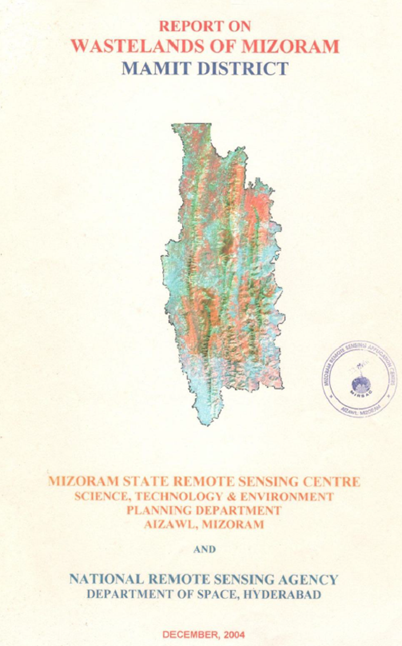
Wastelands on Mizoram - Mamit district
Abstract / Description
The “Report on Wastelands of Mizoram – Mamit District” was prepared under the national Wastelands Atlas Updation Programme coordinated by the National Remote Sensing Agency (NRSA), Department of Space, Government of India, with implementation in Mizoram by the Mizoram State Remote Sensing Centre (MSRSC). The project aimed to update and refine the spatial inventory of wastelands in Mamit District through the application of satellite remote sensing and GIS techniques, thereby providing a scientific basis for land resource planning, reclamation, and sustainable development. The study forms part of a broader state-wide initiative to assess land degradation patterns and monitor changes in wasteland distribution over time.
The study covers the entire Mamit District, located in the north-western part of Mizoram and encompassing a geographical area of approximately 3,025.75 sq. km, accounting for about 14.35% of the total geographical area of the state. Characterized by rugged hill terrain, high rainfall conditions, and extensive forest cover, the district presents a dynamic landscape where land-use practices, particularly shifting cultivation, play a significant role in influencing land degradation processes. The district receives an average annual rainfall of approximately 2,635 mm, creating favorable conditions for vegetation growth while simultaneously increasing susceptibility to soil erosion in disturbed areas.
The principal objective of the project was to identify, classify, and quantify wasteland categories using satellite-derived information and to evaluate changes in wasteland extent since earlier mapping exercises. The study generated district-level and watershed-level statistics and examined the spatial distribution of degraded lands to identify areas requiring priority intervention. Particular emphasis was placed on wasteland categories associated with current shifting cultivation (jhum), young abandoned jhum lands, and degraded forest areas, which represent the dominant forms of land degradation within the district.
The analysis indicates that wastelands occupy approximately 22.76% of the total district area, highlighting the substantial influence of shifting cultivation and associated land-use transitions on the landscape. Watershed-level assessment revealed significant spatial variation in wasteland occurrence, with certain watersheds exhibiting considerably higher concentrations of degraded lands than others. The study identifies shifting cultivation as the primary driver of land degradation, particularly where shortened fallow cycles limit natural vegetation recovery and reduce soil productivity.
A notable observation of the study is the strong relationship between wasteland distribution and traditional land-use practices. Areas under current and recently abandoned jhum cultivation constitute a major proportion of the mapped wastelands, while degraded forest patches reflect cumulative pressures arising from repeated clearing and resource extraction. The report also notes the prevalence of secondary bamboo-dominated vegetation in abandoned jhum areas and highlights ongoing plantation activities in parts of the district as indicators of land restoration efforts.
Overall, the project provides an updated geospatial database and analytical framework for understanding land degradation in Mamit District. The findings serve as an important resource for planners, policymakers, and development agencies by identifying priority areas for reclamation, afforestation, agroforestry, watershed management, and sustainable land-use interventions aimed at improving ecological stability and long-term land productivity.
Summarized Metadata
Mapping Scale: 1:50,000
Satellite data & Year: IRS 1D LISS III, February 2003
Thematic sub-category: Wasteland, Spatial Planning
Collaborating/Funding Agency: National Remote Sensing Centre (NRSC), Hyderabad
Report Publication Month/Year: December, 2004