Access Options
Member Only Content
Please log in to view availability or download this document.
| Published | December 16, 2004 |
|---|---|
| Type | Project Report |
| Thematic Category | Land Resources |
| Project | Wastelands of Mizoram |
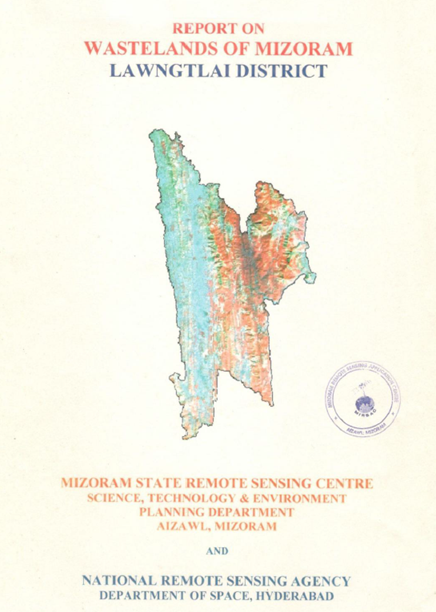
Wastelands of Mizoram - Lawngtlai district
Abstract / Description
The “Report on Wastelands of Mizoram – Lawngtlai District” was prepared under the National Wastelands Atlas Updation Programme coordinated by the National Remote Sensing Agency (NRSA), Department of Space, Government of India, and implemented in Mizoram by the Mizoram State Remote Sensing Application Centre (MSRSC). The project was undertaken to update the inventory of wastelands using satellite remote sensing and GIS technologies, assess temporal changes in land degradation, and generate a scientifically reliable database to support land reclamation, natural resource management, and sustainable development planning. The study forms part of a state-wide effort to monitor the changing status of degraded lands and evaluate the impacts of prevailing land-use practices on the fragile hill ecosystems of Mizoram.
The study covers the entire Lawngtlai District, situated in the southern part of Mizoram between Bangladesh and Myanmar, with a total geographical area of approximately 1,991.19 sq. km, representing about 9.44% of the geographical area of the state. The district is characterized by rugged hill terrain, extensive forest cover, high rainfall conditions, and a predominantly rural population dependent on land-based livelihoods. The region receives an average annual rainfall of approximately 2,558 mm, creating favorable conditions for vegetation growth while simultaneously accelerating erosion processes in disturbed landscapes.
The primary objective of the project was to identify, classify, and quantify various wasteland categories and to evaluate changes that had occurred between the previous wasteland assessment of 1995 and the updated mapping undertaken in 2003. Satellite imagery from the Indian Remote Sensing (IRS) programme was interpreted to delineate wasteland categories and assess their spatial distribution at watershed and district levels. Particular emphasis was placed on land degradation associated with current shifting cultivation (current jhum), abandoned shifting cultivation areas, degraded forest lands, and jhum cultivation occurring within notified forest areas, which are among the most significant drivers of environmental change in the district.
The findings indicate that shifting cultivation remains the dominant land-use practice and the principal contributor to wasteland formation in Lawngtlai District. The study highlights how repeated clearing of forest vegetation and shortening of fallow cycles have transformed large tracts of primary forest into secondary vegetation and degraded landscapes. These changes have resulted in increased soil erosion, nutrient depletion, sedimentation of rivers, and reduced ecological productivity. The assessment reveals that the total wasteland area increased from approximately 377.73 sq. km (18.97%) in 1995 to about 563.79 sq. km (22.05%) in 2003, representing an increase of roughly 3.08% of the district’s geographical area over the study period. The most significant increase was observed in specific watershed regions where expansion of shifting cultivation and forest clearance were particularly pronounced.
The report also documents the occurrence of current jhum cultivation within notified forest areas, indicating continued pressure on forest resources and highlighting the need for improved land-use management. At the same time, the study notes localized examples where degraded lands have been successfully converted to horticultural and agricultural uses, demonstrating the potential for productive reclamation when appropriate interventions are applied.
Overall, the project provides an important geospatial baseline for understanding land degradation trends in Lawngtlai District. The findings offer valuable insights for planners, policymakers, and development agencies by identifying priority areas for ecological restoration, watershed management, afforestation, agroforestry, and sustainable agricultural development. The study further demonstrates the effectiveness of remote sensing and GIS technologies in monitoring landscape change and supporting evidence-based planning for sustainable land resource management in Mizoram.
Summarized Metadata
Mapping Scale: 1:50,000
Satellite data & Year: IRS 1D LISS III, February 2003
Thematic sub-category: Wasteland, Spatial Planning
Collaborating/Funding Agency: National Remote Sensing Centre (NRSC), Hyderabad
Report Publication Month/Year: December, 2004