Urban sprawl study of Aizawl city
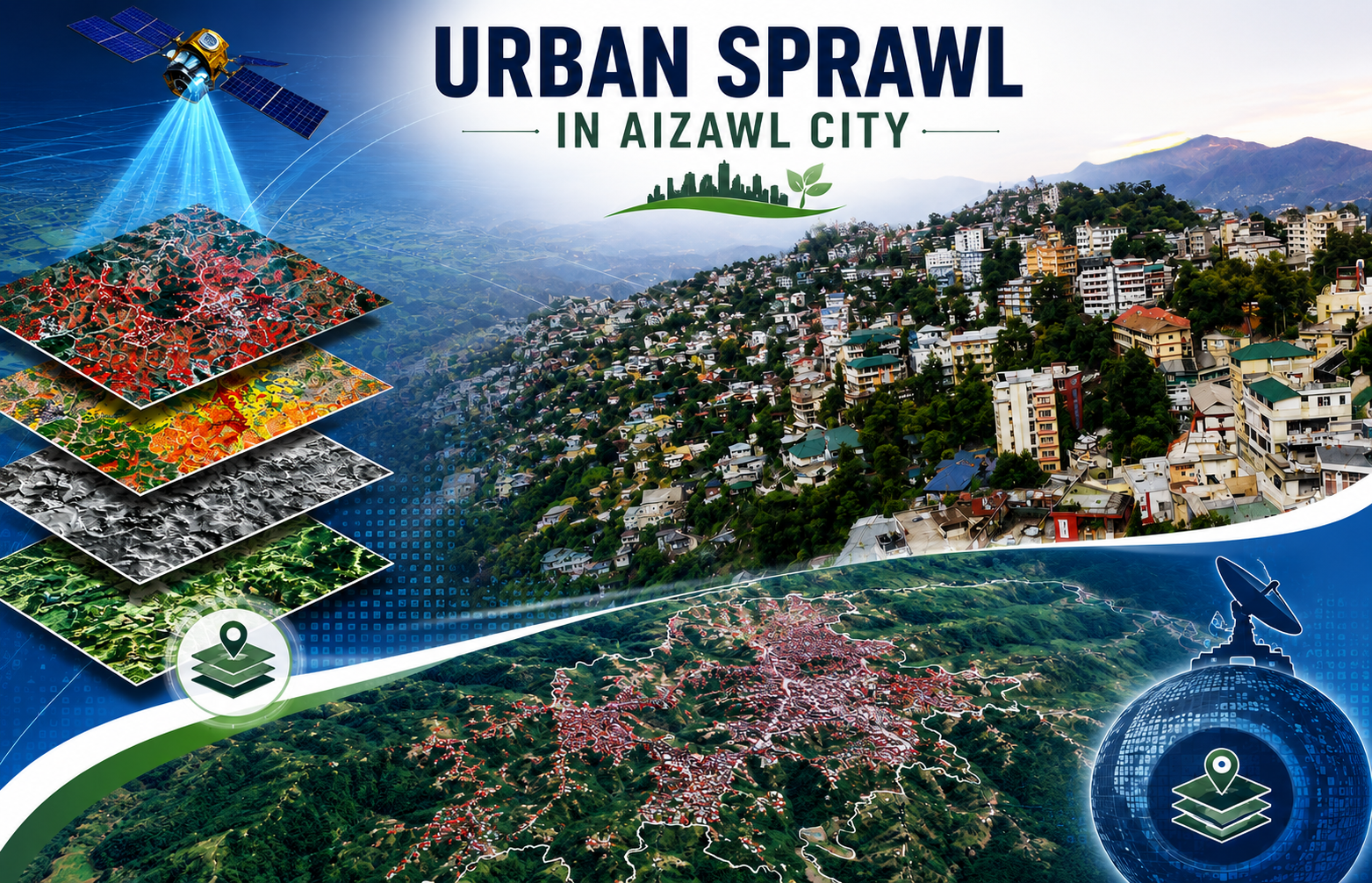
The Urban Sprawl Study of Aizawl City represents a pivotal collaboration between the North Eastern Space Applications Centre (NESAC), Department of Space, Government of India, Umiam, Meghalaya, and the Mizoram Remote Sensing Application Centre (MSRSC), Aizawl, Mizoram. Completed in October 2004 under the supervision of NESAC Director Shri K.C. Bhattacharyya, the project leveraged expertise from principal investigators like Shri ASRKV Murali Mohan (NESAC) and Dr. R.K. Lallianthanga (MIRSAC), alongside a multidisciplinary team of scientists specializing in remote sensing and GIS applications. The core technology employed integrated multi-temporal satellite remote sensing data including Landsat MSS, IRS-1C LISS-III/PAN merged products, and Resourcesat-1 LISS-III with advanced GIS tools for spatial analysis. Data were geometrically registered to 1:25,000 scale Survey of India topographical sheets, processed via visual/digital interpretation techniques, and enhanced with ground truth verification. This enabled precise thematic mapping of land use/land cover, slope (from DEM), transport networks, and surface water bodies, culminating in a comprehensive GIS database linking spatial layers with non-spatial socio-economic attributes from census records and household surveys. The main objective was to monitor Aizawl's urban expansion patterns, evaluate compliance with the 2002 Aizawl Master Plan, and delineate site suitability zones for future growth. Nestled in northern Mizoram's rugged terrain, Aizawl – the capital of Mizoram, faces acute topographic challenges like steep north-south aligned ridges, deep valleys, erosional landforms, acidic loamy soils, and moderate climate (208 cm annual rainfall). Rapid, unplanned sprawl along highways risks exacerbating congestion, water scarcity, erosion, and infrastructure deficits, making this study critically important for sustainable urban management in a hill-station context. The generated outputs such as urban sprawl maps, land use classifications, suitability zonations (prioritizing low-slope, road-proximate wastelands), and integrated databases are invaluable for city and town planning. Planners can use these to decongest the core, direct fringe development, enforce vertical limits, harness springs, and mitigate environmental risks. Aligned partially with the Master Plan, the data supports evidence-based zoning, infrastructure prioritization (e.g., roads, drainage), and policy formulation, fostering controlled growth that balances population pressures with ecological stability. This geospatial framework empowers local authorities, TCP departments, and policymakers to optimize land resources, enhance access to amenities, and promote resilient urbanism amid Aizawl's fragile geology. Summarize Metadata Mapping Scale: 1:25,000 Satellite data & Year: Landsat MSS (1981), IRS-1C (1998-2022), Resourcesat-1 (2003) Study area: Aizawl city (Urban). Collaborating/Funding Agency: North Eastern Space Applications Centre (NESAC), Umiam No. of Report(s) published: 1 Project Period: 2003 – 2004

Wastelands of Mizoram
The “Wastelands of Mizoram” project was undertaken as part of a nationwide initiative of the Department of Space, Government of India, coordinated through the National Remote Sensing Agency (NRSA), Hyderabad, to develop an updated and scientifically reliable inventory of wastelands across the country. In Mizoram, the project was implemented by the Mizoram State Remote Sensing Application Centre (MIRSAC) in close collaboration with NRSA, utilizing standardized methodologies and geospatial technologies to map, classify, and assess wastelands across all eight districts of the state. The primary objective of the project was to generate a comprehensive spatial database of wastelands and degraded land resources using satellite remote sensing and Geographic Information System (GIS) techniques. The study aimed to identify the extent, distribution, and characteristics of wasteland categories prevalent in Mizoram’s unique mountainous environment and to provide a scientific basis for land reclamation, restoration planning, and sustainable resource management. The project recognized the growing need for reliable geospatial information to support informed decision-making in a state where land-use dynamics are strongly influenced by shifting cultivation, forest resource utilization, and challenging terrain conditions. The project employed satellite imagery acquired from Indian Remote Sensing (IRS) satellites, supported by image interpretation, cartographic analysis, GIS integration, and field verification. These technologies enabled the systematic mapping of degraded lands at a uniform scale and facilitated the creation of district-wise and state-level spatial databases. The study covered the entire geographical extent of Mizoram, encompassing diverse physiographic regions ranging from densely forested hill ranges and river valleys to areas affected by land degradation arising from human and natural processes. A key outcome of the project is the generation of a standardized geospatial repository on wastelands that serves as an important reference for planners, policymakers, researchers, and development agencies. The thematic maps, spatial datasets, and accompanying reports provide valuable baseline information for identifying priority areas requiring intervention and for formulating land management strategies suited to local environmental conditions. The project also contributes to a better understanding of the relationship between land-use practices and landscape degradation, thereby supporting long-term planning for ecological restoration and sustainable development. The information generated through this project has significant practical value for a wide range of sectors, including forestry, agriculture, horticulture, watershed development, rural development, and environmental conservation. By providing accurate and spatially referenced information on degraded lands, the project supports the design of targeted reclamation programmes, afforestation initiatives, agroforestry interventions, and watershed management activities. As one of the earliest state-wide geospatial assessments of land degradation in Mizoram, the “Wastelands of Mizoram” project remains an important resource for evidence-based planning and sustainable management of the state’s land resources. Summarize Metadata Mapping Scale: 1:50,000 Satellite data & Year: IRS 1D LISS III (2003) Study area: Mizoram Collaborating/Funding Agency: National Remote Sensing Centre (NRSC), Hyderabad No. of Report(s) published: 8 Project Period: 2003 - 2004
Wasteland Mapping of Mizoram
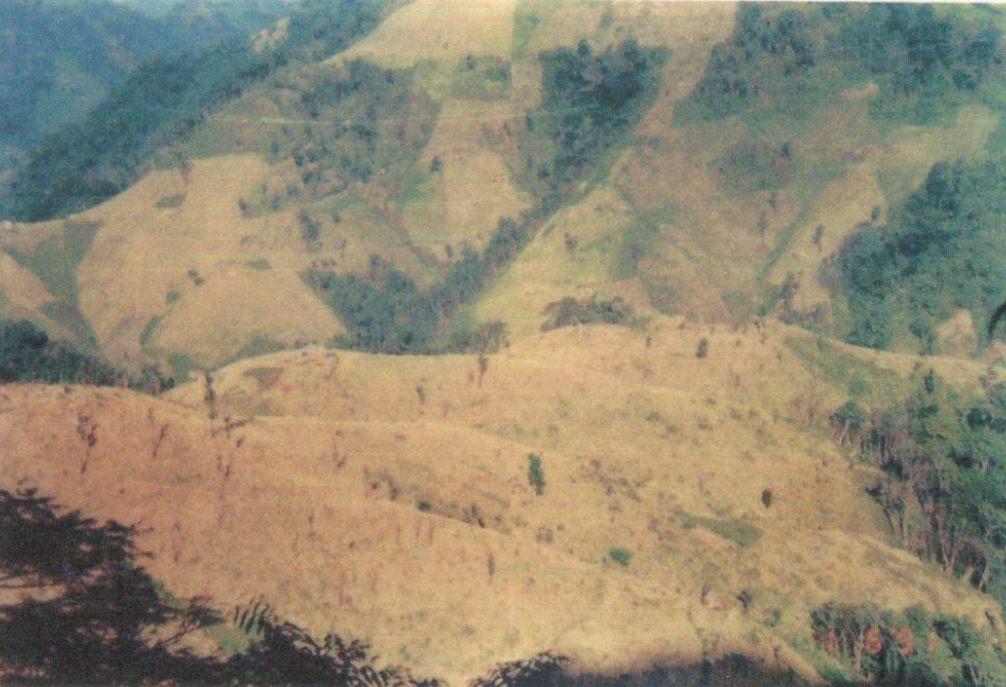
The Wasteland Mapping Project (Phase V) is a nationwide remote sensing initiative undertaken during 1997–1999 under the aegis of the National Remote Sensing Agency (NRSA), Department of Space, Hyderabad, in response to the requirements of the Department of Wasteland Development, Ministry of Rural Areas and Employment, Government of India. The project was conceptualized to generate a systematic and spatially consistent inventory of wastelands across the country to support planning for land reclamation and sustainable resource management. In Mizoram, the responsibility for execution was entrusted to the Mizoram Remote Sensing Application Centre, then functioning under the Science, Technology & Environment Cell, in close coordination with NRSA. The primary objective of the project was to identify, map, and quantify the spatial distribution of wastelands across the three major districts of Mizoram - Aizawl, Lunglei, and Chhimtuipui using satellite remote sensing techniques. The study employed visual interpretation of satellite imagery acquired from the Indian Remote Sensing satellite IRS-1B, utilizing the LISS-II sensor, and mapping was carried out at a scale of 1:50,000. This approach enabled the delineation of wasteland categories within the complex and heterogeneous landscape of Mizoram’s hilly terrain. The analysis identified two major categories of wastelands prevalent in the region: areas under shifting cultivation, including both current and abandoned jhum lands, and degraded notified forest lands. These categories reflect the dominant land-use practices and the associated environmental pressures, particularly the effects of shortened jhum cycles and forest degradation. The project generated district-wise spatial datasets and area statistics, providing a clear representation of the extent and distribution of wastelands. Beyond mapping, the project placed strong emphasis on the productive utilization and rehabilitation of these degraded lands. Based on land capability and ecological suitability, a range of reclamation and management strategies were proposed. These include silvipasture development, sericulture, silviculture, horticulture, agro-horticulture, and improved agricultural practices, each tailored to specific wasteland conditions. The outputs of this project comprising thematic maps, statistical data, and management recommendations serve as a foundational geospatial database for planners and policymakers. The study provides critical baseline information to support scientifically informed decision-making, enabling the formulation of targeted programmes for wasteland development, ecological restoration, and enhancement of land productivity in Mizoram. Summarize Metadata Mapping Scale: 1:50,000 Satellite data & Year: IRS 1B (1995) Study area: Aizawl, Lunglei & Chhimtuipui districts. Collaborating/Funding Agency: National Remote Sensing Centre (NRSC), Hyderabad No. of Reports published: 3 Project Period: 1997 - 1999
Land Use / Land Cover Mapping of Mizoram
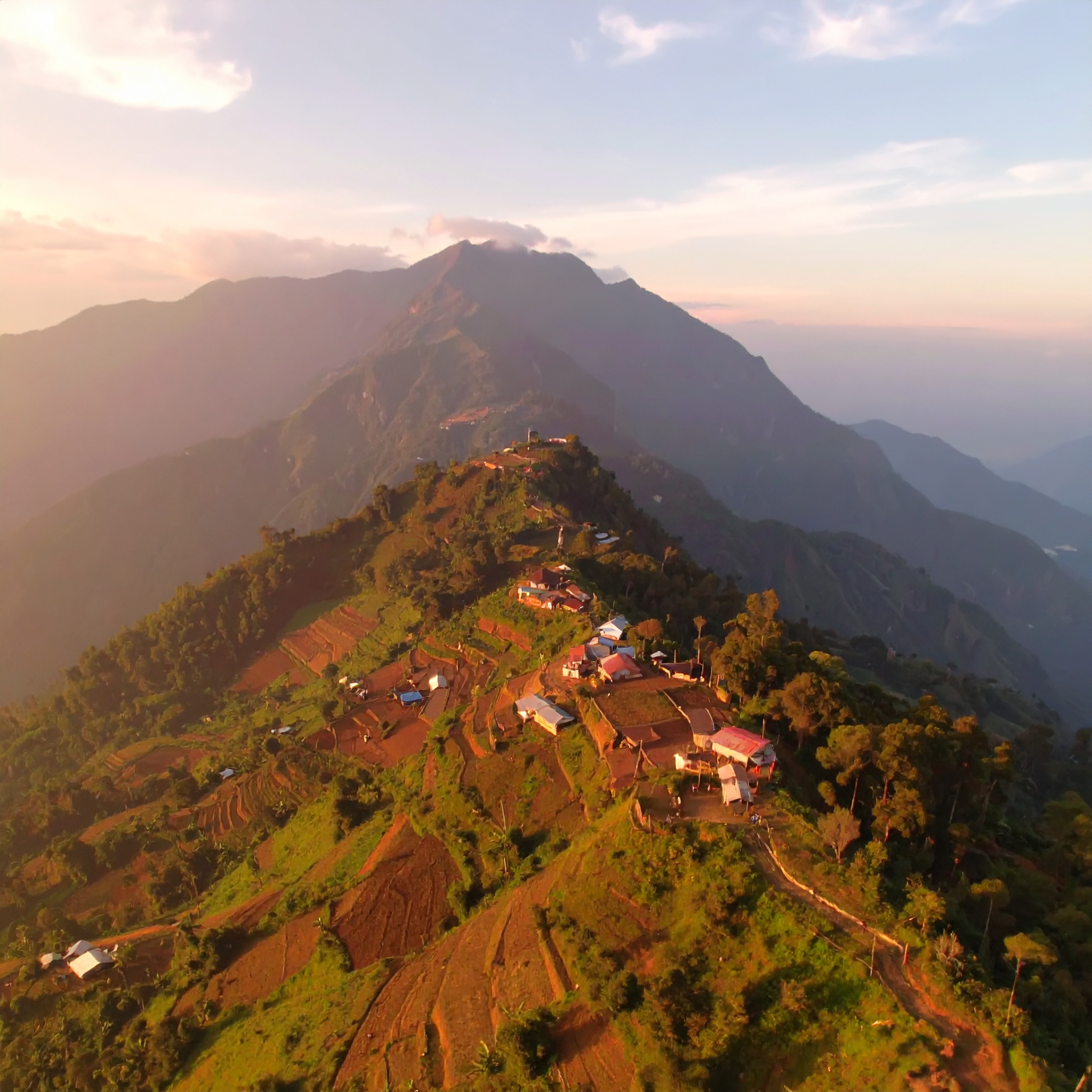
The Land Use / Land Cover (LULC) mapping of Mizoram was undertaken to generate a systematic and spatially consistent assessment of land use patterns across three main districts – namely Aizawl, Lunglei & Chhimtuipui using remote sensing and GIS techniques. The project aimed to establish a reliable geospatial baseline that would support district-level planning, environmental monitoring, and sustainable resource management in the districts. The primary objective of the project was to identify, classify, and map the major land use and land cover categories prevailing within the administrative boundary of the study districts. The study sought to produce standardized thematic maps and associated spatial statistics that could be readily used by line departments, planners, and researchers. Emphasis was placed on creating a uniform and replicable dataset that could also serve as a reference for future land use change studies. Satellite remote sensing data formed the core input for the analysis, supplemented by GIS-based spatial processing and interpretation. Established land use / land cover classification schemes were followed to ensure thematic consistency with national and institutional standards. Image interpretation techniques were applied to delineate different land cover classes, and ancillary datasets such as administrative boundaries and existing reference information were used to enhance spatial accuracy. Institutional expertise and domain knowledge played a key role in refining classifications, particularly in areas with mixed or transitional land use patterns. Summarize Metadata Mapping Scale: 1:250,000 Satellite data & Year: Landsat TM, 1989 Major Land Use / Land Cover categories: Built-up, Agriculture, Forest, Water bodies, Shifting cultivation & Abandoned jhum. Collaborating/Funding Agency: National Remote Sensing Centre (NRSC), Hyderabad No. of Reports published: 2 Project Period: 1989 - 1990