Digital Mapping of Village Boundary of Mizoram
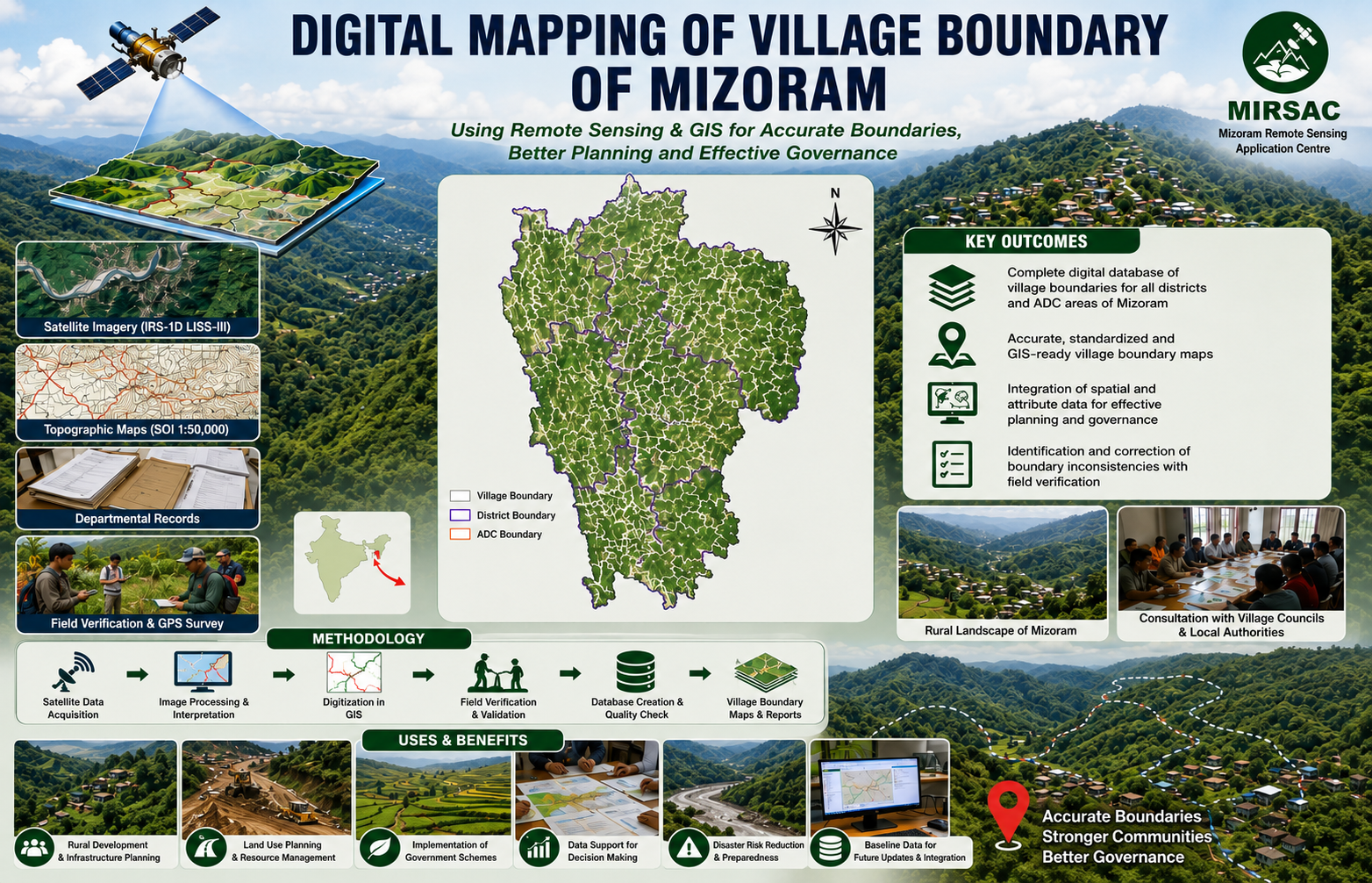
The Digital Mapping of Village Boundary of Mizoram using Remote Sensing and GIS was undertaken as an in-house project by the Mizoram Remote Sensing Application Centre (MRSAC) under the Science & Technology, Planning Department, Government of Mizoram. The project was developed to address the need for accurate and standardized village boundaries for micro-level planning, administrative management and equitable implementation of development programmes across the State. The study covered the entire geographical area of Mizoram, including all eight districts and the village jurisdictions administered through the State Government and the Lai, Mara and Chakma Autonomous District Councils. The principal objective was to prepare a comprehensive digital village-boundary database that could be maintained, updated and used by MRSAC and other government departments for future planning and administrative purposes. The project integrated IRS-1D LISS-III satellite imagery, Survey of India topographic sheets at 1:50,000 scale, departmental land records, field observations and local administrative information. Satellite data were geometrically corrected and interpreted using ERDAS Imagine, while digitization, database preparation and spatial analysis were undertaken in ARC/INFO GIS. Field verification, handheld GPS observations and consultations with Village Councils and local communities were used to resolve doubtful or inaccessible boundary sections. Institutional collaboration formed an important component of the project. The Land Revenue & Settlement Department, Local Administration Department, local administrative offices and the three Autonomous District Councils provided preliminary records and jurisdictional information required for validation. Existing departmental maps were compared with satellite-derived information, enabling anomalies and inconsistencies in village boundaries to be identified and corrected. The resulting digital maps and associated spatial and non-spatial database provide a reliable reference for village-level administration and development planning. The outputs can support rural infrastructure development, land-use planning, resource allocation, census and socio-economic analysis, watershed and natural resource management, implementation of area-specific schemes and coordination among government departments. By presenting village locations, extents and administrative relationships in an accessible digital format, the project created an important baseline for decentralized planning in Mizoram. The maps and report remain valuable to planners, administrators, researchers, development agencies and user departments requiring accurate village-level spatial information for evidence-based decision-making. Summarize Metadata Mapping Scale: 1:50,000 Satellite data & Year: IRS 1D – LISS III (2006) Study area: Mizoram Collaborating/Funding Agency: Science, Technology & Environment Wing, Planning Department, Government of Mizoram No. of Report(s) published: 1 Project Period: 2006 - 2008
Mapping of Forest Administrative Boundary of Mizoram
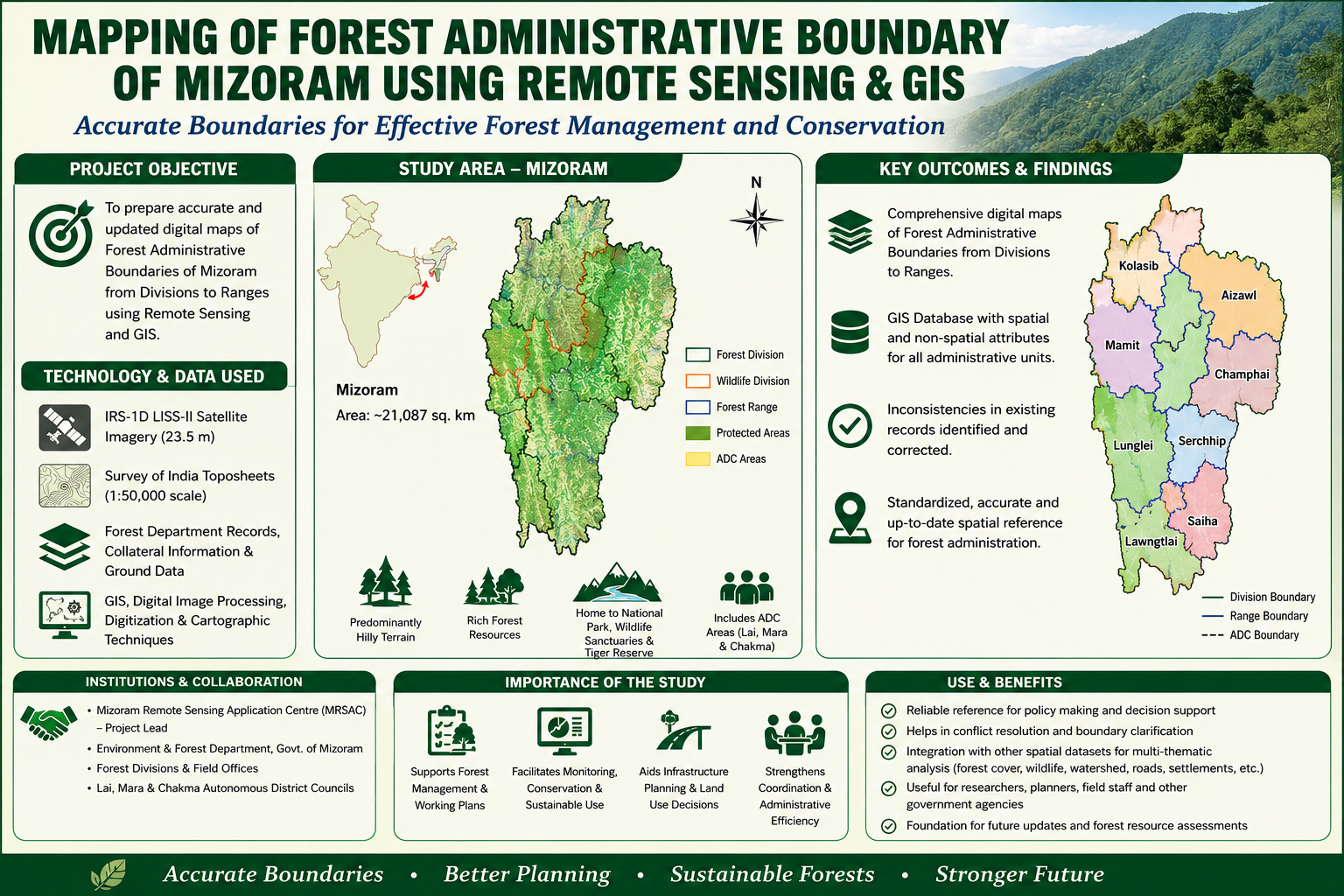
The Mapping of Forest Administrative Boundary of Mizoram using Remote Sensing and GIS was undertaken as an in-house project of the Mizoram Remote Sensing Application Centre (MRSAC) under the Science & Technology, Planning Department, Government of Mizoram, and was included in the Centre's Annual Plan for 2007–08. The project was conceived in recognition of the critical ecological and socio-economic importance of Mizoram's forests and the need for an accurate, standardized, and spatially referenced delineation of the administrative framework responsible for their conservation, management, and sustainable utilization. The primary objective was to prepare comprehensive digital Forest Administrative Boundary maps of Mizoram, covering the hierarchical administrative units of the Forest Department, from Forest Divisions and Wildlife Divisions to Forest Ranges and other relevant administrative units. The project covered the entire State of Mizoram, an area of approximately 21,087 sq. km, characterized by predominantly hilly terrain and extensive forest resources. The mapping also incorporated important protected and conservation areas, including Murlen National Park, Khawnglung, Thorang, Tawi and Lengteng Wildlife Sanctuaries, Zoological Park, Dampa Tiger Reserve, and forest areas administered by the Lai, Mara and Chakma Autonomous District Councils. The project integrated IRS-1D LISS-III satellite imagery with 23.5 m spatial resolution, Survey of India topographic sheets at 1:50,000 scale, departmental records, collateral information, and ground data. Satellite imagery and existing Forest Department records were compared and integrated using Remote Sensing, GIS, digital image processing, digitization, and cartographic techniques. This approach enabled inconsistencies and anomalies in existing boundary information to be identified and corrected, while providing a systematic means of updating and standardizing the spatial representation of forest administrative units. The resulting maps were prepared at appropriate scales for different administrative areas, with important spatial and non-spatial attributes embedded within the digital database. The project involved close coordination with the Environment & Forest Department, Government of Mizoram, whose officers and staff provided preliminary administrative information and departmental records. Inputs were also obtained from the Forest Divisions and staff of the three Autonomous District Councils—Lai Autonomous District Council (LADC), Mara Autonomous District Council (MADC), and Chakma Autonomous District Council (CADC). This institutional collaboration was essential for validating existing administrative information and ensuring that the resulting geospatial products reflected the operational framework of forest administration in the State. The principal outcome was a comprehensive set of illustrated Forest Administrative Boundary maps and a digital GIS database covering the State's forest administrative structure. These outputs provide a reliable spatial reference for the Environment & Forest Department, forest managers, planners, researchers, and other government agencies. The database can support forest resource conservation, monitoring, sustainable utilization, working-plan preparation, field-level administration, infrastructure planning, and area-specific development programmes. It also provides an effective framework for integrating forest administrative boundaries with other geospatial datasets, including forest cover, land use, biodiversity, protected areas, watersheds, roads, settlements, and other natural resource information. Overall, the project demonstrated the value of Remote Sensing and GIS as cost-effective and efficient tools for demarcating, updating, and managing complex administrative boundaries in a forested and mountainous landscape. The resulting maps, digital datasets, and associated report constitute an important baseline reference for systematic forest administration and provide a foundation for improved coordination, monitoring, planning, and sustainable management of Mizoram's valuable forest resources. Summarize Metadata Mapping Scale: 1:50,000 Satellite data & Year: IRS 1D LISS III (2006) Study area: Mizoram Collaborating/Funding Agency: Mizoram Remote Sensing Application Centre No. of Report(s) published: 1 Project Period: 2006 - 2008
Tiger Habitat Analysis in Dampa Tiger Reserve, Mizoram
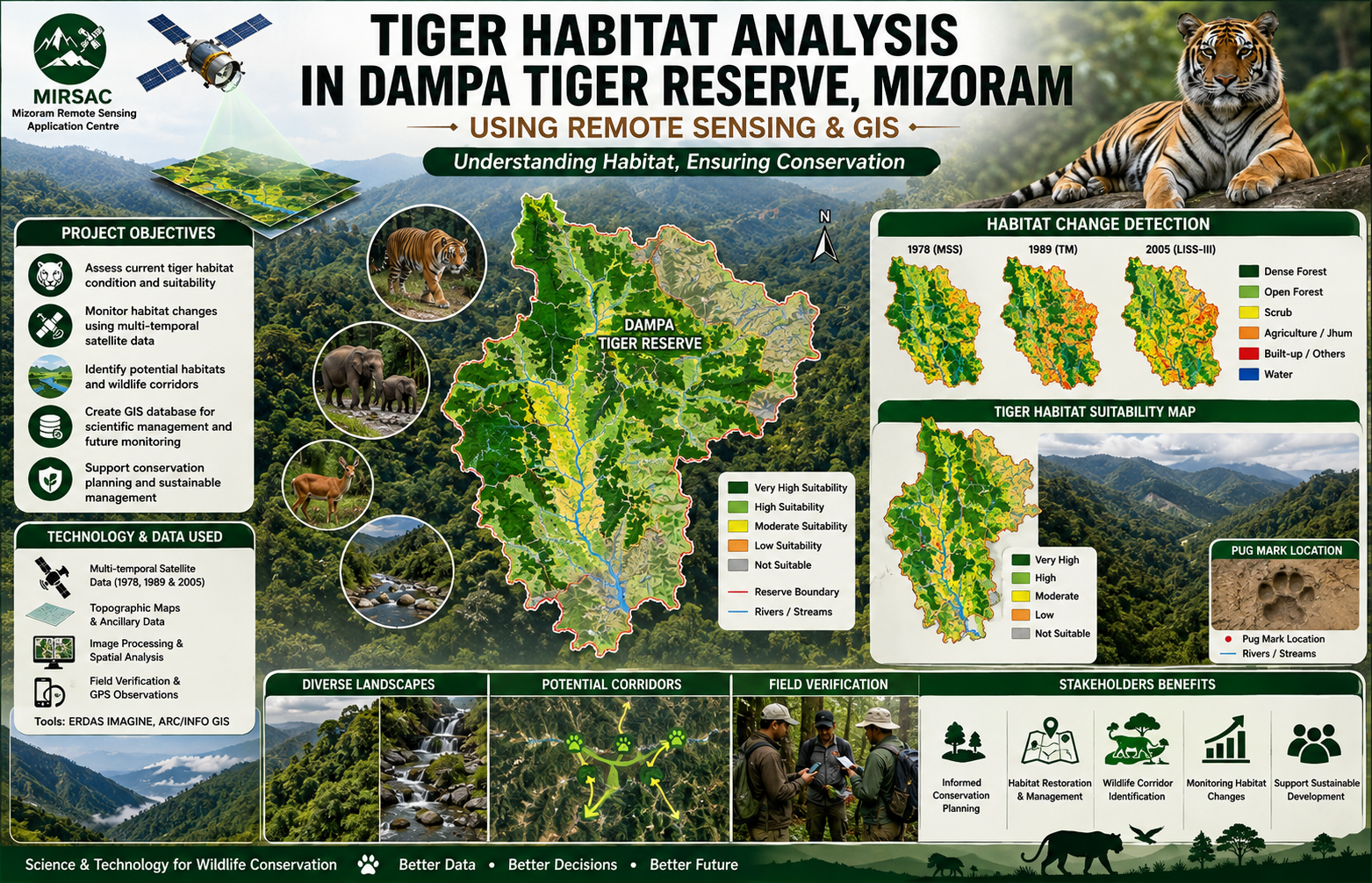
The project “Tiger Habitat Analysis in Dampa Tiger Reserve, Mizoram using Remote Sensing and GIS” was undertaken to evaluate the condition and suitability of tiger habitat within Dampa Tiger Reserve and its surrounding landscape, and to support scientific conservation and management planning through geospatial technologies. The study was carried out in close association with Northeastern Space Application Centre (NESAC) and Environment & Forest Department, Government of Mizoram, which provided reserve boundaries, wildlife census information and other field-level data required for analysis. The main objectives were to prepare an inventory of vegetation types, forest density and water bodies, assess long-term habitat changes, characterize suitable tiger habitat, identify possible habitat and corridor areas outside the reserve, and create a digital database for future management. The project employed a multi-temporal Remote Sensing and GIS approach using Landsat MSS data from 1978, Landsat TM data from 1989, IRS-1D LISS-III and PAN data, and IRS-P6 LISS-III imagery from 2005, supported by topographic information, socio-economic data from surrounding villages and field verification. GIS-based spatial modelling integrated vegetation type, forest density, slope, aspect, elevation, proximity to water and observed tiger pug-mark locations to develop a tiger habitat suitability model and map. The surrounding buffer area was also examined to evaluate habitat continuity and potential corridors beyond the reserve boundary. The importance of the study lies in its ability to link wildlife observations with measurable landscape characteristics and long-term vegetation change. The report identifies degradation and fragmentation of closed evergreen and semi-evergreen forests, largely associated with shifting cultivation and other biotic pressures, as important threats to tiger habitat quality. The resulting habitat suitability maps, vegetation and forest-density datasets, change-analysis outputs and digital GIS database provide valuable baseline information for the Forest Department, wildlife managers, conservation planners and researchers. These outputs can support habitat restoration, monitoring of forest degradation, management of buffer zones, identification of wildlife corridors, prioritization of conservation interventions and periodic assessment of habitat change, thereby strengthening long-term conservation planning for Dampa Tiger Reserve and its surrounding landscape. Summarize Metadata Mapping Scale: 1:50,000 Satellite data & Year: Landsat MSS (1978), Landsat TM (1989), IRS 1D LISS III (1999), IRS 1D PAN (2003), IRS P6 LISS-III (2005). Study area: Dampa Tiger Reserve Collaborating/Funding Agency: North Eastern Space Applications Centre (NESAC) & Environment & Forest Department, Government of Mizoram. No. of Report(s) published: 1 Project Period: 2005 – 2008
Natural Resources Mapping of Mizoram
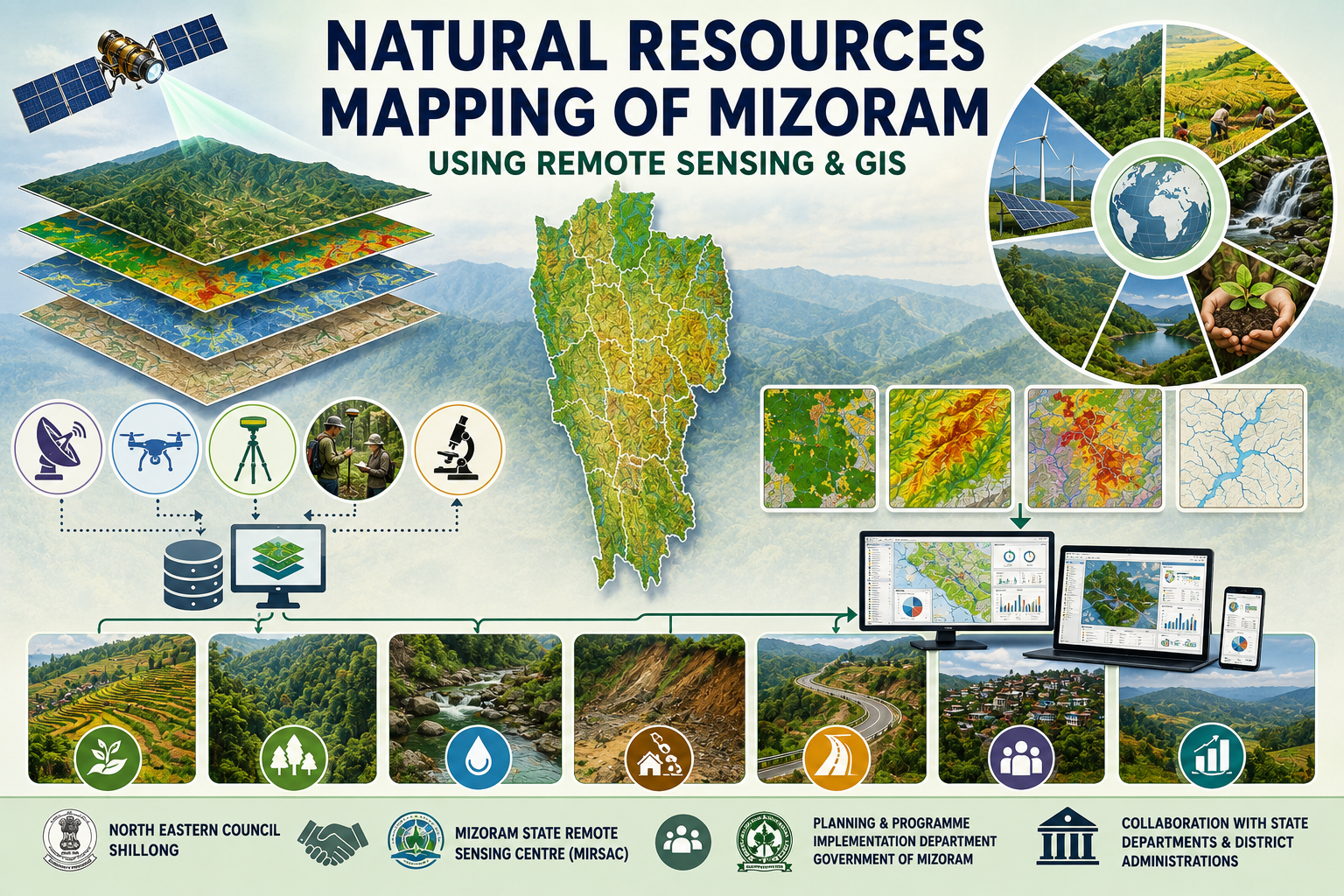
The Natural Resources Mapping of Mizoram using Remote Sensing and GIS is a flagship geospatial resource inventory project undertaken by the Mizoram State Remote Sensing Centre (MSRSC) under the Science, Technology & Environment Wing, Planning Department, Government of Mizoram, with financial support from the North Eastern Council (NEC), Shillong. Initiated in 2004 as a three-year programme, the project was implemented in a district-wise phased manner to systematically cover the entire state and develop a comprehensive geospatial database of Mizoram's natural resources. It represents one of the earliest large-scale initiatives in the state to integrate satellite Remote sensing and Geographic Information System (GIS) technologies for natural resource assessment and development planning. The primary objective of the project was to create standardized thematic maps and digital spatial databases covering the state's major natural resources, thereby providing reliable scientific information for sustainable planning and management. Using high-resolution Indian Remote Sensing (IRS-1D LISS-III and Panchromatic) satellite imagery, supported by Survey of India topographic maps, field verification, GPS and GIS-based spatial analysis, the project generated a comprehensive inventory of natural resources across Mizoram. Major thematic layers include land use/land cover, geology, geomorphology, soils, drainage, watershed boundaries, groundwater potential, slope, aspect, transport network, and settlements. These thematic datasets were digitized and integrated within a GIS environment to enable spatial analysis and preparation of resource-based action plans. The project covered the entire geographical extent of Mizoram, encompassing its diverse physiographic regions, mountainous terrain, river basins, forests, agricultural landscapes, and rural settlements. By adopting a uniform methodology across all districts, the project established a consistent and scientifically validated geospatial database capable of supporting planning at district, watershed, and state levels. The integrated assessment provides a holistic understanding of the interrelationships between land, water, terrain, and other natural resources, facilitating informed decision-making for sustainable development. One of the most significant outcomes of the project is the creation of statewide natural resources information that serves as a valuable reference for government departments, researchers, planners, academic institutions, and development agencies. The thematic maps and digital databases provide critical baseline information for watershed management, agriculture and horticulture development, forestry, groundwater exploration, infrastructure planning, disaster risk reduction, environmental conservation, and land capability assessment. The project also enables resource monitoring, identification of development potential, and formulation of scientifically based action plans tailored to local conditions. By demonstrating the effective integration of Remote Sensing, GIS, GPS, and field observations, the project established a modern framework for geospatial planning in Mizoram. Even today, the datasets and reports generated under this initiative remain an important repository of baseline information for multidisciplinary research, policy formulation, environmental assessment, and evidence-based planning. As one of the pioneering state-wide geospatial mapping programmes supported by the North Eastern Council, the project has significantly strengthened the application of space technology in natural resource management and continues to provide lasting value for the sustainable development of Mizoram. Summarize Metadata Mapping Scale: 1:50,000 Satellite data & Year: IRS 1D PAN & LISS III (2003 & 2004) – Digital & Photo print Study area: Mizoram Collaborating/Funding Agency: North Eastern Council (NEC), Shillong No. of Report(s) published: 8 Project Period: 2004 – 2007
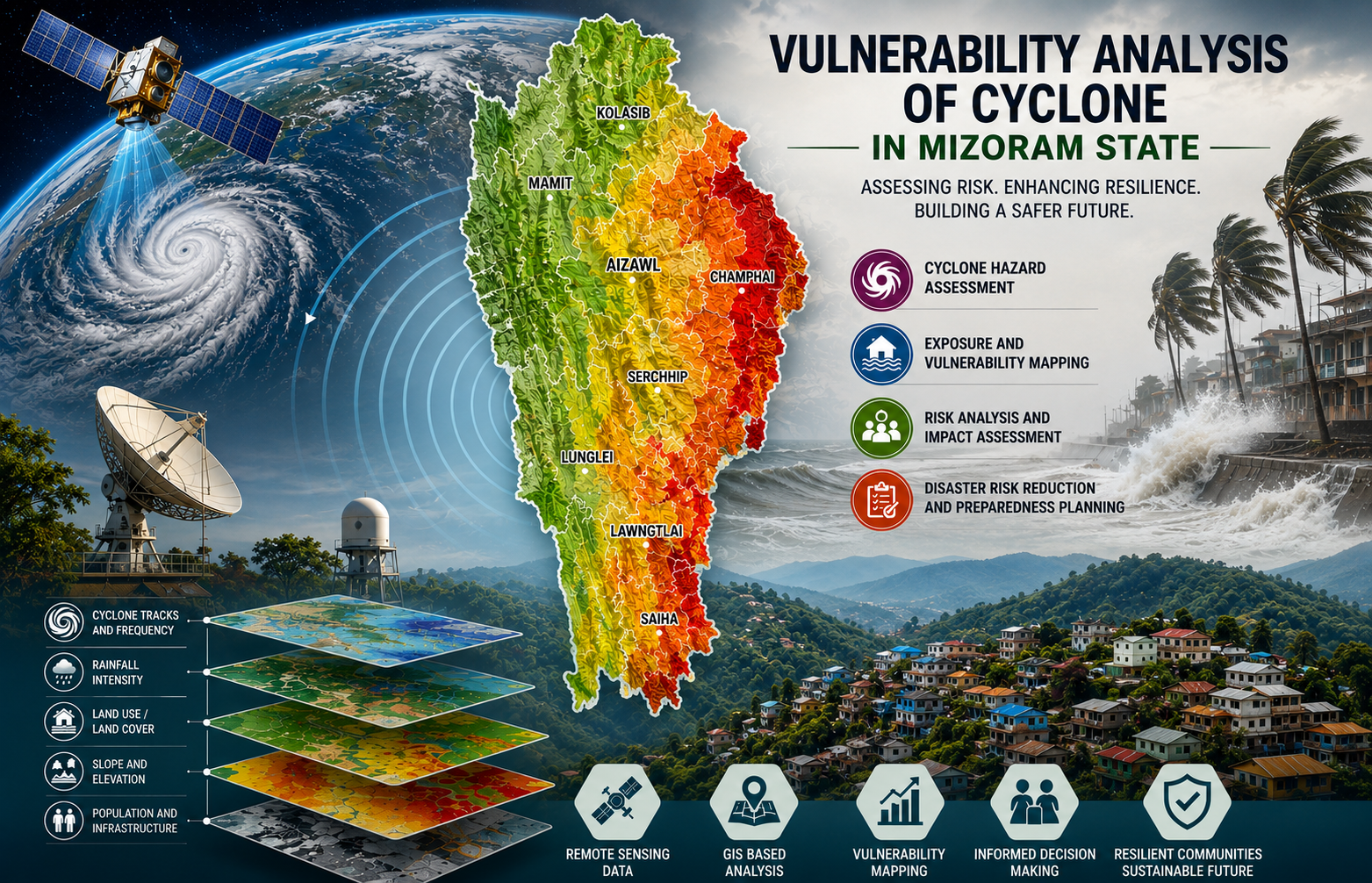
Vulnerability analysis of cyclone in Mizoram
The Vulnerability Analysis of Cyclone in Mizoram State is a key initiative by the State Remote Sensing Centre (SRSC), under the Science, Technology & Environment Wing, Planning Department, Government of Mizoram, Aizawl. Initiated following a Hazard Mapping meeting on April 13, 2004, chaired by Pu K. Riachho, Secretary of Relief & Rehabilitation, the project received funding from the Relief & Rehabilitation Department. The project harnessed SRSC's expertise in remote sensing for rapid execution, completed in December 2004. Advanced geospatial technologies formed the backbone, including visual analysis of IRS LISS-III False Colour Composites (FCC), Survey of India (SOI) topographical maps, and historical cyclone records (1985–2004) from district Deputy Commissioners and Relief & Rehabilitation Directorate. Integrated with 2001 Census data, ArcInfo GIS software enabled classification of 828 villages/towns/wards into vulnerability zones (high, medium, low) based on occurrence, frequency, physiography (ridge/hill-top vs. slope/valley), aspect, and altitude. This produced detailed thematic maps and tables overlaying cyclone-prone locations across Mizoram's eight districts. The primary objective was to assess cyclone vulnerability statewide for enhanced disaster preparedness and mitigation and the first such effort by SRSC. Mizoram, wedged between Bangladesh/Myanmar with NNW-SSE trending ridges (elev. 40–2,157 m, e.g., Phawngpui), young tertiary sediments (Surma/Barail groups), trellis/dendritic drainage (e.g., Tlawng, Chhimtuipui rivers), and humid tropical climate (250–350 cm rainfall), faces cyclone tails from Bay of Bengal (post/pre-monsoon). Impacts include house/powerline damage, road blockages, crop/livestock losses, amplified by predominant Assam-type/timber-thatched structures on exposed ridges. The study underscores urgency for risk mapping in this topographically vulnerable, agriculturally dependent region with 888,573 population (2001). Generated reports/maps for village/ward/district-wise vulnerability (location/aspect/altitude analyses), cyclone history overlays are transformative for city/town planning. They guide resilient zoning (avoiding saddles/ridge-tops >501 m), building codes (wind-resistant designs: sloping roofs, anchors, braces), site selection (leeward/shielded), and infrastructure (reinforced walls, windbreaks). Planners can prioritize retrofitting (e.g., J-bolts, bands), integrate into District Disaster Management Plans, and foster mitigation (e.g., tree belts). This database empowers disaster management authorities to minimize losses, enhance recovery, and build cyclone-resilient settlements amid frequent moderate storms. Summarize Metadata Mapping Scale: 1:50,000 Satellite data & Year: IRS LISS III (2003) Study area: Mizoram Collaborating/Funding Agency: Relief & Rehabilitation Department, Govt. of Mizoram No. of Report(s) published: 1 Project Period: 2004