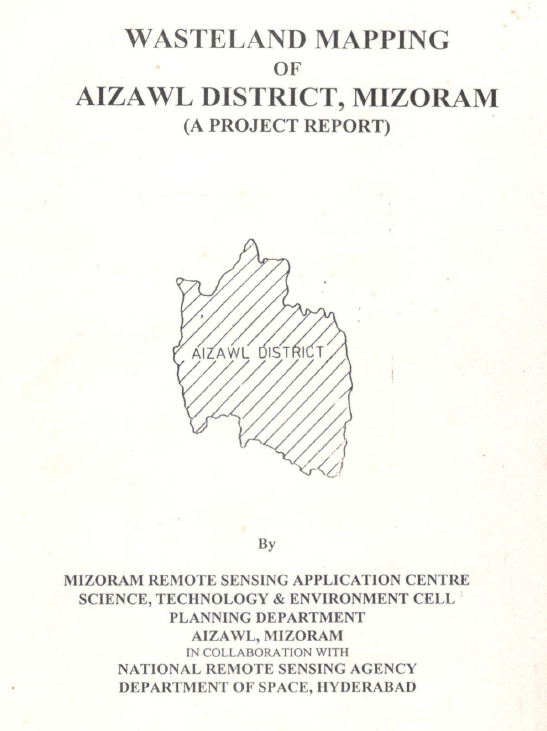
Wasteland Mapping of Aizawl District, Mizoram
The Wasteland Mapping Project for Aizawl district was undertaken as part of the nationwide Phase V programme initiated by the National Remote Sensing Agency (NRSA), Department of Space, Government of India, during 1997–99. The project aimed to generate a systematic spatial database on wasteland distribution to support scientific planning for land resource development and ecological restoration. In Mizoram, the study was carried out by the Mizoram Remote Sensing Application Centre under the Science, Technology & Environment Cell, Planning Department, in coordination with NRSA, Hyderabad.The primary objective of this district-level study was to identify, delineate, and quantify wasteland categories within Aizawl district using satellite remote sensing techniques. The analysis was based on visual interpretation of IRS-1B LISS-II geocoded False Colour Composites (FCCs) acquired in 1995 at a scale of 1:50,000, supplemented by ground truth verification, Survey of India topographical sheets, and ancillary data. This approach enabled accurate mapping of degradation amid steep slopes (>50° dominant), high rainfall (2,802 mm annual average), and Surma Group geology prone to erosion.The study identified shifting cultivation (jhum) as the dominant wasteland category, comprising current jhum (743.52 sq km; 5.91% of district area) and abandoned jhum/scrub (1,684.37 sq km; 13.38%) alongside degraded notified forest land (193.05 sq km; 1.53%; e.g., Dampa Wildlife Sanctuary). Total wastelands spanned 2,620.94 sq km (20.82%), with hotspots in topo sheets 84E8 (33.48%), 84A5 (26.64%), and watersheds like 3D1B6b (36.65%). These reflect jhum-driven erosion, nutrient depletion, and forest conversion in hilly terrain.The project generated detailed thematic maps, watershed-wise statistics, and a digital vector database, providing a baseline for land degradation dynamics and priority interventions.A key component was site-specific reclamation strategies tailored to slope, soil (pH 4-6.5, loamy skeletal), and location: silvipasture (e.g., Ficus hirta, Stylosanthes spp.) on hilltops; sericulture (Morus indica); silviculture (Tectona grandis); horticulture (Citrus spp., Musa spp.); agro-horticulture with Sloping Agricultural Land Technology (SALT); and wetland rice via irrigation. The findings offer policymakers and agencies a geospatial framework for sustainable development, optimizing resources and mitigating jhum impacts in Aizawl district.Summarized MetadataMapping Scale: 1:50,000Satellite data & Year: IRS 1B (1995)Thematic sub-category: Wasteland, Spatial Planning Collaborating/Funding Agency: National Remote Sensing Centre (NRSC), HyderabadReport Publication Month/Year: July, 1999
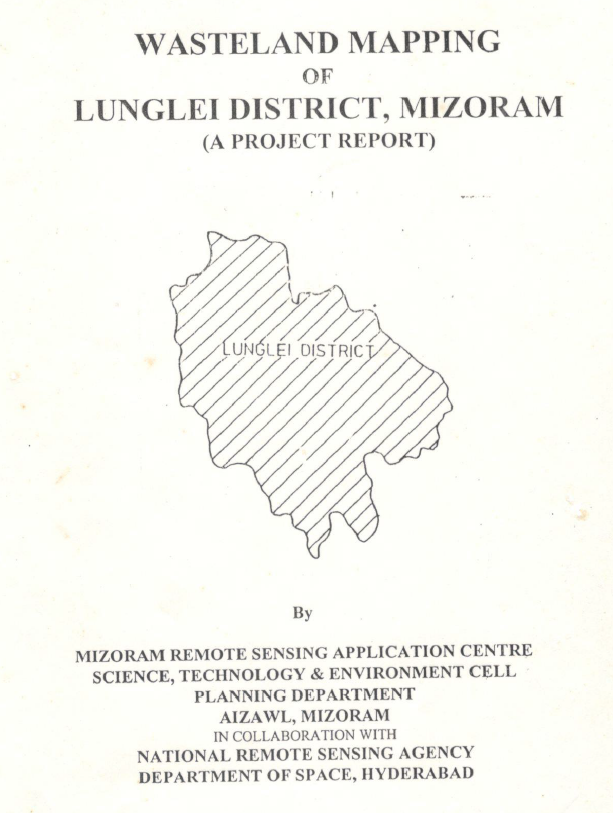
Wasteland Mapping of Lunglei District, Mizoram
The Wasteland Mapping Project for Lunglei district was undertaken as part of the nationwide Phase V programme initiated by the National Remote Sensing Agency (NRSA), Department of Space, Government of India, during 1997–99. The project aimed to generate a systematic spatial database on wasteland distribution to support scientific planning for land resource development and ecological restoration. In Mizoram, the study was carried out by the Mizoram Remote Sensing Application Centre under the Science, Technology & Environment Cell, Planning Department, in coordination with NRSA, Hyderabad.The primary objective of this district-level study was to identify, delineate, and quantify wasteland categories within Lunglei district (4,536 sq km) using satellite remote sensing techniques. The analysis was based on visual interpretation of IRS-1B LISS-II geocoded False Colour Composites (FCCs) acquired in 1995 at a scale of 1:50,000, supplemented by ground truth verification, Survey of India topographical sheets, and ancillary data. This approach enabled accurate mapping of degradation amid steep slopes, high rainfall (2,817 mm annual average, peaking August at 506 mm), and Surma Group geology (sandstone, shale, siltstone).The study identified shifting cultivation (jhum) as the dominant wasteland category, comprising current jhum (205.76 sq km; 4.54% of district area) and abandoned jhum/scrub (494.74 sq km; 10.91%), alongside degraded notified forest land (33.01 sq km; 0.73%; e.g., Khawnglung Reserved Forest). Total wastelands spanned 733.51 sq km (16.17%). These reflect jhum-driven erosion, nutrient depletion, and forest conversion in central-southern Mizoram's terrain.The project generated detailed thematic maps and a digital vector database, providing a baseline for land degradation dynamics and priority interventions. A key component was site-specific reclamation strategies tailored to slope, acidic soils (pH 4-6.5), and location: silvipasture (e.g., Ficus hirta, Stylosanthes spp.) on hilltops; sericulture (Morus indica); silviculture (Tectona grandis); horticulture (Citrus spp., Musa spp.); agro-horticulture with Sloping Agricultural Land Technology (SALT); and wetland rice via irrigation.The findings offer policymakers and agencies a geospatial framework for sustainable development, optimizing resources and mitigating jhum impacts in Lunglei district. Summarized MetadataMapping Scale: 1:50,000Satellite data & Year: IRS 1B (1995)Thematic sub-category: Wasteland, Spatial Planning Collaborating/Funding Agency: National Remote Sensing Centre (NRSC), HyderabadReport Publication Month/Year: July, 1999
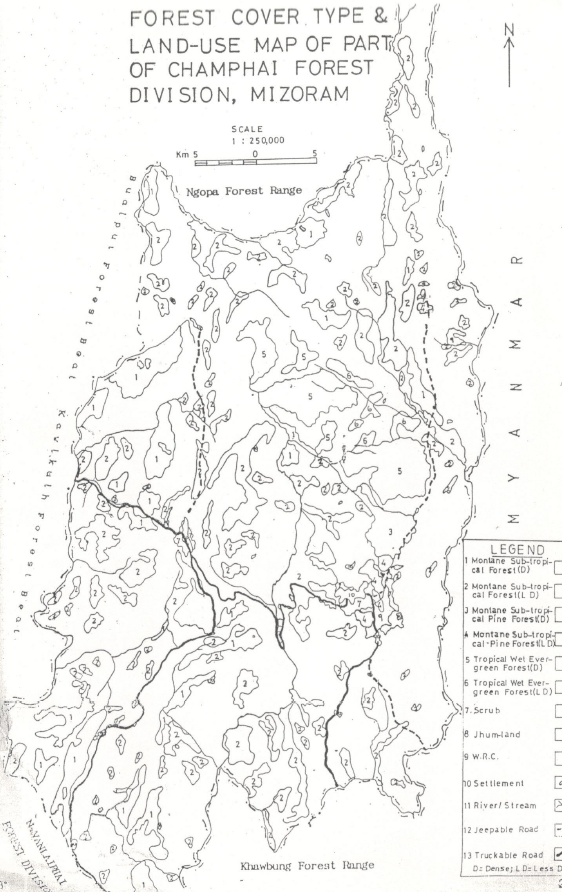
Studies on dynamics of Shifting Cultivation and its influence on forest ecosystem by Satellite Remote Sensing techniques
The project report authored by Dr.R.K.Lallianthanga, MSRSC investigates the spatial and temporal dynamics of shifting cultivation (jhum) and its ecological influence on forest ecosystems, with the dual aim of (1) testing the capability of satellite remote sensing and GIS to detect and quantify jhum cycles in the study area, and (2) linking remotely-sensed land-cover change with on-the-ground ecological indicators (vegetation structure, species composition and biomass/productivity). Initiated as an in-house study at MSRSC, the work combines multi-temporal satellite imagery, image classification and change-detection techniques with stratified field sampling (phytosociological surveys, biomass estimation and fallow-age stratification) to establish an integrated picture of how jhum practices alter landscape structure and ecological condition of forests over time. The project area covers part of Champhai Forest division. The study area was selected so as to exclude bamboo forests and confine studies in Montane sub-tropical forests and Tropical Wet Evergreen forests. Methodology employed multi-temporal Landsat TM image analysis to delineate land-cover classes relevant to jhum dynamics (active cultivation, recent clearings, multiple fallow classes, regenerating vegetation and closed forest). Imagery interpretation and GIS processing were used to map patch boundaries, compute area statistics, and produce time-series maps showing transitions between classes. The remote sensing analyses were calibrated and validated using field observations: plots stratified by fallow age were sampled for species composition, stem density, and aboveground biomass; these in-situ measurements were used to interpret remotely sensed signatures and to assess recovery trajectories across different fallow durations. The report documents the classification approach, sampling design, and the protocols used for biomass and productivity estimation.Principal outcomes demonstrate that multi-temporal satellite data, when combined with targeted field validation, can reliably identify shifting cultivation patches and distinguish fallow classes in Mizoram’s complex terrain. The study produced thematic LULC maps showing the spatial distribution of active jhum, recent clearings and regenerating fallows, together with GIS-ready datasets and area statistics for each mapped class. Field-based phytosociological results indicate progressive recovery of vegetation complexity and biomass with increasing fallow age; species composition shifts from early-successional herbs and shrubs in newly abandoned sites to progressively woody and structurally complex stands in longer fallows, consistent with measured increases in aboveground biomass and stem density. The report also outlines observed relationships between fallow age and key ecological metrics (documented in tabular form), and discusses implications for carbon stock recovery, soil conservation and biodiversity conservation in jhum mosaics.The study highlights both the strengths and limitations of the applied approach. Remote sensing provides robust spatial coverage and repeatability for monitoring jhum at landscape scale, but classification accuracy is constrained by small patch size, steep slopes and mixed land-use signals. Such inherent issues alleviated by higher temporal resolution imagery and systematic field calibration. The report concludes with practical recommendations for operational monitoring (preferred temporal resolution, field-validation density, and fallow-age stratification), and positions the products as baseline datasets for planners and forest managers engaged in sustainable land-use interventions. Summarized MetadataMapping Scale: 1:250,000Satellite data & Year: Landsat TM, Multi-temporal prior to 1993Thematic sub-category: Forest, Shifting CultivationCollaborating/Funding Agency: Mizoram State Remote Sensing Application Centre (MSRSC)Report Publication Month/Year: April, 1993
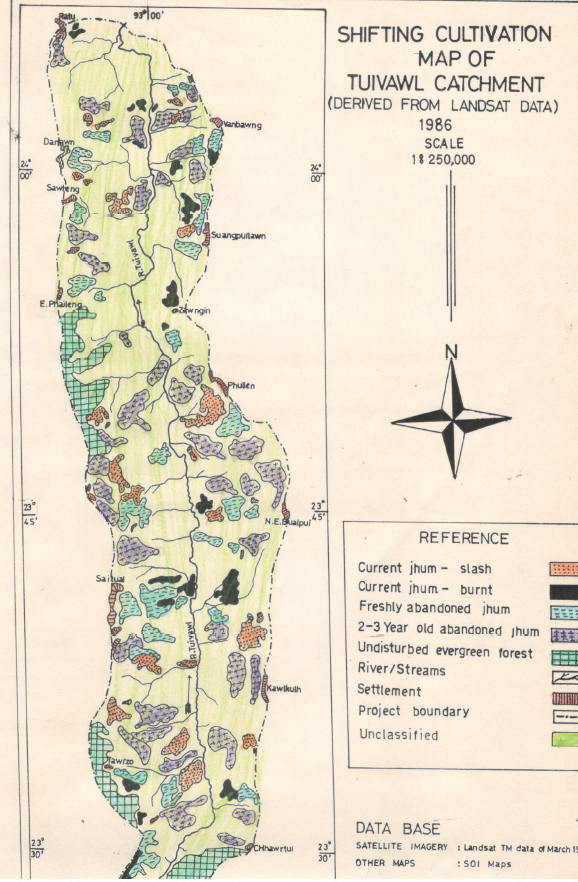
Analysis of Shifting Cultivation dynamics using Remote Sensing techniques & Status Report on Flora and Fauna of Tuivawl Catchment, Aizawl District, Mizoram.
The report authored by Pu Lalnunsiama Colney, MSRSC produced under the in-house initiative “Study of Shifting Cultivation Dynamics using Satellite Remote Sensing Techniques”, presents a focused, catchment-scale assessment of shifting cultivation (jhum) practices in the Tuivawl catchment of Aizawl District, Mizoram, with the explicit aim of jhum dynamics in Tuivawl catchment area using Landsat TM satellite data. The study concentrates on the cyclical land-use processes that define shifting cultivation - clearing, cultivation, abandonment and fallow regeneration - and evaluates how these phases are represented in multi-temporal remotely sensed imagery when interpreted with geospatial techniques and supported by local knowledge. Satellite imagery constitutes the principal data input. Imagery was processed and analysed using GIS workflows to delineate land-cover classes relevant to jhum dynamics (active cultivation, recent clearings, fallow stages, regenerating vegetation and relatively stable forest). The methodology adopted in the study includes visual interpretation of satellite imagery (Landsat TM) from 1986 and 1989, focusing on color tones to identify cultivation stages. The area affected by jhum cultivation was approximately 11,860 hectares (13.58%) in 1986 and 12,620 hectares (14.46%) in 1989. Current jhum areas were identified as 2,480 hectares in 1986 and 2,620 hectares in 1989. Freshly abandoned jhum areas were 2,540 hectares in 1986 and 2,740 hectares in 1989. The study highlights the ecological impacts of shifting cultivation and the need for sustainable alternatives. Multi-temporal comparison of images enabled the identification of land-use transitions and the estimation of temporal patterns consistent with fallow-cycle behavior. Ancillary spatial data and field observations were used to refine thematic assignments and to resolve mixed or ambiguous signatures that commonly arise in smallholder, mosaic landscapes and steep slopes. The methodological emphasis is on establishing repeatable, institutionally adoptable procedures for mapping jhum at catchment scale rather than producing a single, one-off inventory. A notable component of the report is an ecological status note describing local flora and fauna within the Tuivawl catchment. The report lists various species of animals, birds, and reptiles found in the Tuivawl catchment, emphasizing the need for conservation efforts. This section contextualizes remote observations by linking landscape-scale changes with on-the-ground biological conditions, thereby strengthening the ecological interpretability of remotely sensed change signals. By integrating species-level and habitat information with mapped land-cover transitions, the study offers a more comprehensive picture of how shifting cultivation interacts with biodiversity and habitat condition at catchment scale.Overall, the analysis demonstrates that remotely sensed multi-temporal analysis, when combined with local knowledge and targeted field checks, can produce operationally useful information on shifting cultivation dynamics at catchment scale. The study serves as both a methodological test case and a baseline spatial record for the Tuivawl catchment.Summarized MetadataMapping Scale: 1:250,000Satellite data & Year: Landsat TM, 1986 & 1989Thematic sub-category: Shifting Cultivation, WatershedCollaborating/Funding Agency: Mizoram State Remote Sensing Application Centre (MSRSC)Report Publication Month/Year: April, 1991
Land Use / Land Cover of Aizawl District, Mizoram
The Land Use / Land Cover (LULC) mapping of Aizawl district was undertaken to generate a systematic and spatially consistent assessment of land use patterns across the district using remote sensing and GIS techniques. The project aimed to establish a reliable geospatial baseline that would support district-level planning, environmental monitoring, and sustainable resource management in one of Mizoram’s most rapidly transforming regions. The primary objective of the project was to identify, classify, and map the major land use and land cover categories prevailing within the administrative boundary of Aizawl district. The study sought to produce standardized thematic maps and associated spatial statistics that could be readily used by line departments, planners, and researchers. Emphasis was placed on creating a uniform and replicable dataset that could also serve as a reference for future land use change studies.Satellite remote sensing data formed the core input for the analysis, supplemented by GIS-based spatial processing and interpretation. Summarized abstract of Land Use/Land Cover in the district: Built-up land: 5,062.5 ha (0.40% of total area).Agricultural land: 3,286.5 ha (0.26% of total area), primarily Kharif crops. Forest land: 1,168,485.5 ha (92.82% of total area), including evergreen and bamboo forests. Water bodies: Major rivers and streams, with ongoing dam construction for hydroelectric power.Others: Shifting cultivation (53,062.5 ha, 4.21%) and abandoned jhum/shrubs (29,112.5 ha, 2.31%)Summarized MetadataMapping Scale: 1:250,000Satellite data & Year: Landsat TM, 1989Thematic sub-category: Land Use, Land Cover Collaborating/Funding Agency: National Remote Sensing Centre (NRSC), HyderabadReport Publication Month/Year: March, 1990